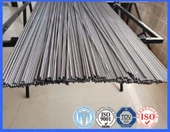
Why Choose Titanium Pipes?
Titanium pipes are a cornerstone of modern industrial equipment. Their key advantages include:
Excellent Corrosion Resistance: Titanium pipes outperform stainless steel and nickel-based alloys in harsh environments, particularly against chlorides, sulfides, and ammonia, making them ideal for chemical processing and offshore applications .
High Strength-to-Weight Ratio: Titanium's strength is comparable to some steels but at about half the density. This lightweight property is crucial for aerospace and automotive applications, reducing weight without sacrificing performance .
Superior Performance in Extreme Conditions: They maintain integrity in both high-pressure, high-temperature environments (like oil and gas deep wells) and cryogenic conditions .

A Detailed Look at Common Titanium Pipe Grades
The properties of titanium pipes are primarily determined by their alloy composition. The following table summarizes the most common grades you will encounter.
| Grade | UNS Number | Key Characteristics | Primary Applications |
|---|---|---|---|
| Commercially Pure (CP) Grades 1, 2, 3 | R50250, R50400, R50500 | Excellent formability, weldability, and corrosion resistance. Grade 2 is the most widely used. | Heat exchangers, condensers, chemical processing piping . |
| Grade 5 / Ti-6Al-4V (TC4) | R56400 | High strength, good fatigue resistance, and can be used at moderately elevated temperatures. | Aerospace components, high-pressure hydraulic systems, medical implants, and marine engineering . |
| Grade 7 / Ti-0.2Pd | R52400 | Enhanced corrosion resistance, especially in reducing acids, due to Palladium addition. | Chemical processing equipment where resistance to acidic environments is critical. |
| Grade 9 / Ti-3Al-2.5V | R56320 | Good strength and ductility, often used for seamless tubing. | Aerospace hydraulic systems, bicycle frames, and other high-performance applications. |
| Grade 12 / Ti-0.3Mo-0.8Ni | R53400 | Excellent corrosion resistance across a wide range of temperatures and acidic conditions. | Chemical process industry for shells and heat exchangers. |
The Manufacturing Process: Seamless vs. Welded
Understanding how titanium pipes are made is key to selecting the right type for your application.
Seamless Titanium Pipes: These are manufactured through extrusion or advanced rotary piercing processes like tandem skew rolling (TSR). This method involves heating a solid billet and piercing it to create a hollow shell, which is then rolled to the desired size .
Advantages: Homogeneous structure, no weld seam, superior performance under high pressure, better uniformity in wall thickness .
Typical Sizes: Smaller diameters; commonly up to 108mm OD .
Welded Titanium Pipes: These are made by rolling a titanium plate or coil into a tube and welding the seam.
Advantages: More cost-effective for large diameters, can be produced in longer continuous lengths.
Typical Sizes: Larger diameters, from 100mm to over 600mm OD .
Modern techniques like tandem skew rolling allow for the production of high-quality seamless titanium alloy tubes with high dimensional accuracy and no surface defects, significantly improving production efficiency . For the highest reliability in critical applications, seamless pipes are often the preferred choice.
Key Applications Across Industries
The unique properties of titanium pipes make them indispensable in several high-tech sectors.
Aerospace & Defense: Used in hydraulic systems, fuel lines, and airframe components where lightweight and high strength are non-negotiable .
Chemical Processing, Petrochemical & Offshore: The material of choice for heat exchangers, condensers, and process piping that handle highly corrosive chemicals and seawater .
Power Generation: Nuclear power industries have adopted titanium tubes as a standard material for condenser and heat exchanger tubes due to their long-term reliability .
Medical Technology: Certain grades, like Ti-6Al-4V (Grade 5), are biocompatible and used for surgical implants and medical device components .
Oil & Gas: Recent advancements have led to the development of titanium alloy continuous pipes for deep-sea and ultra-deep wells, offering superior performance in high-H₂S and CO₂ environments .
Why Partner with TSM TECHNOLOGY CO., LTD.?
At TSM TECHNOLOGY CO., LTD., we are more than just a supplier; we are your technical partner in solving complex engineering challenges. Our capabilities include:
Expertise in Advanced Manufacturing: We leverage cutting-edge processes to supply both seamless and welded titanium pipes that meet the most stringent international standards, including ASTM B337, ASTM B338, and GB/T3625 .
Precision and Quality Assurance: Our quality control ensures that every pipe delivers consistent performance, with precise dimensional accuracy and superior metallurgical properties.
Customized Solutions: We understand that every project is unique. We offer tailored solutions to meet specific dimensional, performance, and budgetary requirements.