


Grade 2 Titanium is widely used in industrial equipment because it combines corrosion resistance, formability, and weldability. However, its corrosion performance is not determined by material grade alone. Operating temperature can change the stability of its protective oxide film and affect how the metal responds to acids, chlorides, crevices, and other process conditions.
For engineers selecting Grade 2 Titanium, the key question is how temperature interacts with process chemistry, equipment design, and operating conditions.
This article explains how temperature affects Grade 2 titanium corrosion resistance and what to consider when selecting Grade 2 titanium tube and plate for elevated-temperature service.
1. Why Does Grade 2 Titanium Resist Corrosion?
Grade 2 is a commercially pure titanium grade. Its corrosion resistance mainly comes from a thin, stable, strongly adherent oxide film that forms naturally when titanium is exposed to oxygen or an oxidizing environment.
This passive film acts as a barrier between the metal and the surrounding medium. If the film is locally damaged and the environment supports repassivation, a new protective film can form. This helps Grade 2 Titanium perform well in many seawater, chloride-containing, and chemical-processing applications.
Passivity is not unconditional. Strong reducing acids, fluoride-containing solutions, certain hot concentrated chemicals, and oxygen-depleted crevices can challenge the protective film. Actual corrosion behavior depends on the complete service environment, not just the nominal grade.
Key point: Grade 2 Titanium resists corrosion because of its passive oxide film. Temperature matters because it can influence the formation, stability, and breakdown of this film.
2. How Does Temperature Affect Grade 2 Titanium Corrosion Resistance?
2.1 Higher Temperature Can Accelerate Corrosion Reactions
As temperature increases, electrochemical reactions and chemical transport processes often become faster. In an environment that can attack titanium, this may increase metal dissolution or change the passive film.
The effect is important in hot acidic solutions. Some reducing acids can dissolve or destabilize titanium's passive film. If the environment cannot support effective repassivation, corrosion may become more severe as temperature rises.
A higher temperature does not automatically mean Grade 2 Titanium will corrode. In a compatible oxidizing environment, the passive film may remain protective. The solution chemistry must be considered together with temperature.
2.2 Temperature Can Affect the Passive Oxide Film
Temperature can affect oxide growth, dissolution, defect formation, and the ability of the surface to repassivate after damage. In some environments, a stable oxide layer continues to protect the metal as temperature increases. In others, especially strongly reducing or contaminant-rich solutions, the film may become less protective.
Research on titanium and titanium alloys shows that the temperature response can be nonlinear. Results from one alloy or test solution should not be treated as a universal temperature limit for Grade 2 Titanium.
2.3 Temperature Can Change Localized Corrosion Risk
Localized corrosion can be more difficult to predict than general surface corrosion. Crevices under gaskets, deposits, lap joints, and tight-fitting components can create conditions that differ from the bulk solution.
Inside a crevice, oxygen may become depleted and solution chemistry can change. When temperature, chloride concentration, geometry, and restricted mass transfer act together, crevice corrosion risk may increase.
A reported result for Grade 2 Titanium in a particular near-oxygen-free seawater crevice test has indicated susceptibility under specific conditions around 80°C. This is not a universal maximum service temperature. It illustrates why temperature must be assessed together with crevice geometry, oxygen availability, and water chemistry.
3. Does Grade 2 Titanium Have a Maximum Service Temperature for Corrosion Resistance?
There is no single temperature that defines the corrosion limit of Grade 2 Titanium in every environment. A temperature acceptable in clean, well-aerated water may not be suitable in a hot reducing acid or an oxygen-depleted crevice.
Use this table as a qualitative screening guide. It is not a design rating or a substitute for corrosion testing under representative process conditions.
| Service condition | Temperature-related consideration | What to evaluate |
|---|---|---|
| Ambient or moderate-temperature, compatible aqueous service | The passive film is generally stable in many suitable environments. | Water chemistry, contaminants, deposits, and crevice design. |
| Elevated-temperature chloride service | Higher temperature can increase localized corrosion concerns in demanding geometries or oxygen-poor areas. | Chloride level, oxygen content, crevices, deposits, and flow. |
| Hot reducing acid | The passive film may dissolve or fail to remain protective; corrosion can increase. | Acid type, concentration, temperature, redox condition, and inhibitors. |
| Fluoride-containing process media | Fluoride can attack the protective oxide film; temperature and concentration may intensify the concern. | Fluoride concentration, pH, temperature, and exposure duration. |
3.1 Temperature in Seawater and Chloride Service
Grade 2 Titanium is widely considered for seawater and many chloride-containing applications because of its passive-film performance. Heat exchangers, condensers, desalination equipment, and water-treatment systems are common examples.
For elevated-temperature chloride service, do not assess chloride concentration alone. Oxygen availability, crevice geometry, surface deposits, flow, and shutdown conditions can influence localized corrosion. A narrow crevice that remains wet may behave differently from an openly exposed surface.
3.2 Temperature in Acidic Environments
Titanium's performance in acids varies significantly with acid type and concentration. Some oxidizing environments support passivation, while strongly reducing acids can attack the passive film. Temperature can change the balance between film formation and dissolution.
For phosphoric acid, hydrochloric acid, sulfuric acid, and mixed-acid processes, review concentration, impurities, dissolved metals, aeration, and process temperature together. A general statement such as "titanium is acid resistant" is not enough for equipment design.
4. Other Factors That Work Together With Temperature
4.1 Acid Concentration and pH
Acid concentration and pH influence the chemical conditions at the titanium surface. The effect is specific to the acid system; increasing concentration does not produce the same response in every acid. Evaluate concentration and temperature as a combination.
4.2 Dissolved Oxygen and Aeration
Oxygen can support formation and maintenance of titanium's passive film. Poorly aerated regions, stagnant zones, and tight crevices may behave differently from the main process stream. Consider normal operation and idle periods.
4.3 Fluoride and Other Contaminants
Fluoride is particularly important because it can destabilize or dissolve titanium oxide. Contaminants may change material suitability depending on concentration, pH, temperature, and exposure time. Confirm the full process composition rather than relying only on the primary chemical name.
4.4 Flow Velocity and Surface Deposits
Flow affects heat transfer, mass transport, and suspended solids. Deposits can create shielded areas with chemistry that differs from the bulk fluid. Review flow velocity, solids loading, cleaning procedures, and possible erosion or deposit-related attack.
5. Selecting Grade 2 Titanium Tube for High-Temperature Applications
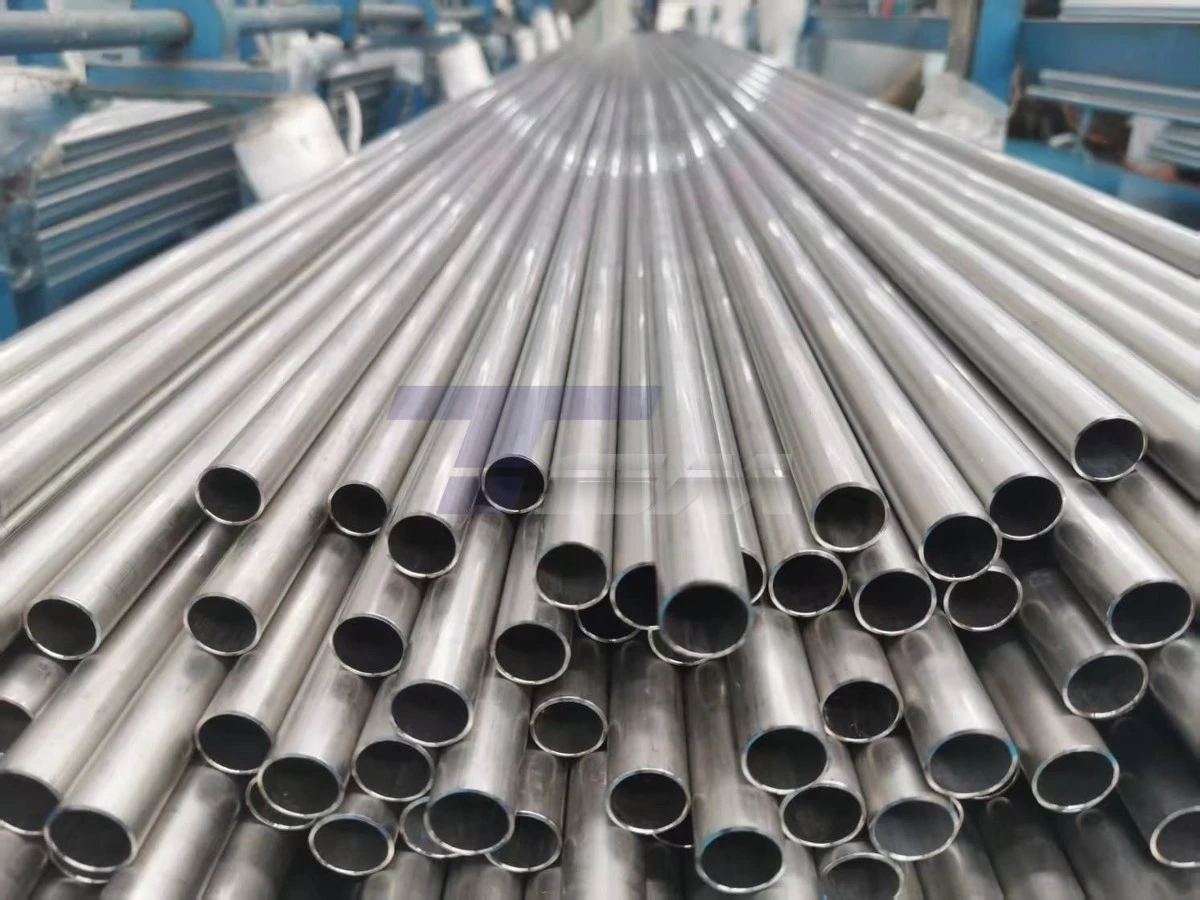
When selecting Grade 2 Titanium tube for a heat exchanger, condenser, evaporator, or process pipeline, start with the operating environment. Confirm normal and maximum temperatures, pressure, fluid composition, chloride and fluoride levels, pH, oxygen condition, and expected service life.
Then confirm tube dimensions, manufacturing route, applicable product standard, and inspection requirements. Depending on the project, buyers may specify seamless or welded tube, outside diameter, wall thickness, length, heat-treatment condition, surface finish, and testing documentation.
TSM supplies Grade 2 Titanium tube in project-specific dimensions. Available product information includes ASTM B338 / ASME SB338 requirements, outside diameters from 3–219 mm, and wall thicknesses from 0.1–100 mm, subject to order review and manufacturing feasibility. Inspection and documentation requirements should be confirmed in the purchase specification.
- Confirm the applicable standard and grade designation.
- Specify outside diameter, wall thickness, length, and dimensional tolerances.
- Define the required condition, surface finish, and manufacturing route.
- State inspection, testing, traceability, and material-document requirements.
- Review corrosion suitability against the actual process chemistry and temperature.
Explore our ASTM B861 Titanium Pipe product information and contact us with your required dimensions and service conditions.
6. Selecting Grade 2 Titanium Plate for Elevated-Temperature Equipment
Grade 2 Titanium plate and sheet may be used in chemical-processing equipment, tanks, linings, heat-transfer components, and fabricated structures. For elevated-temperature service, material selection should consider both corrosion resistance and mechanical requirements.
Specify thickness, width, length, surface condition, applicable standard, and forming or welding requirements. ASTM B265 is commonly specified for titanium and titanium alloy strip, sheet, and plate. The project specification should define the exact product form and acceptance requirements.
TSM offers Grade 2 Titanium sheet and plate options, with product dimensions and conditions subject to confirmation. For a reliable quotation, provide the intended application, operating temperature, chemical medium, plate dimensions, and inspection requirements.
View our Grade 2 Titanium Sheet product page for more information.
7. How to Evaluate Grade 2 Titanium Before Raising the Operating Temperature
If you plan to increase the operating temperature of existing equipment, do not rely on the material grade alone. A structured review can help identify conditions that may affect corrosion performance.
- Document the process chemistry. Record major chemicals, concentration ranges, pH, chloride, fluoride, dissolved oxygen, and possible contaminants.
- Define the temperature profile. Include normal, maximum, start-up, shutdown, cleaning, and upset temperatures.
- Review equipment geometry. Identify gasket interfaces, lap joints, deposits, stagnant areas, and potential crevices.
- Check the evidence. Use corrosion data or tests that represent the actual alloy, solution chemistry, temperature, and exposure conditions.
- Confirm material and fabrication details. Verify grade, product standard, weld procedure, surface condition, and material traceability.
- Set an inspection plan. Determine inspection locations, intervals, and acceptance criteria based on equipment risk.
Engineering reminder: Laboratory results are meaningful only when test conditions represent the service environment. Do not apply a temperature threshold from a different titanium grade, acid composition, or test geometry directly to Grade 2 Titanium.
8. Why Material Traceability Matters
Corrosion-resistant equipment depends on more than choosing a suitable alloy. Buyers also need confidence that supplied material matches the purchase specification and can be traced through inspection and documentation.
TSM Technology is a China-based titanium manufacturer supplying titanium tubes, plates, bars, forgings, fasteners, flanges, and custom-machined components for industrial applications. The company reports more than 15 years of manufacturing experience, a 60,000 m² production facility, supply to more than 70 countries, and quality systems including AS9100 and ISO 9001.
Its manufacturing and quality-control capabilities include titanium processing, tube production, CNC machining, ultrasonic testing, eddy-current testing, material identification, mechanical testing, and dimensional inspection. Material documentation and inspection scope should be agreed upon for each order.
For elevated-temperature or corrosive service, provide operating conditions when requesting a quotation. This helps the team review product form, dimensions, standards, and documentation requirements.
9. Frequently Asked Questions
Q1. Does Grade 2 Titanium lose corrosion resistance at high temperatures?
Not necessarily. Grade 2 Titanium can remain corrosion resistant in many suitable environments at elevated temperatures. However, temperature can accelerate reactions and affect passive-film stability. The result depends on the chemical medium and service conditions.
Q2. What is the maximum temperature for Grade 2 Titanium in corrosive environments?
There is no universal maximum corrosion-service temperature. The acceptable temperature depends on chemical composition, concentration, oxygen availability, crevice conditions, and exposure time. A process assessment or representative corrosion test is recommended.
Q3. Is Grade 2 Titanium suitable for hot seawater?
Grade 2 Titanium is used in many seawater and chloride applications, but hot seawater service requires attention to crevices, deposits, oxygen depletion, and water chemistry. Do not treat a single test temperature as a general service limit.
Q4. Does temperature affect Grade 2 Titanium's oxide film?
Yes. Temperature can influence oxide-film growth, dissolution, defects, and repassivation. Whether the film remains protective depends on the surrounding solution and its oxidizing or reducing characteristics.
Q5. Can Grade 2 Titanium tube be used in high-temperature heat exchangers?
It may be suitable for heat exchangers in compatible process environments. Engineers should review fluid composition, temperature, pressure, chloride and fluoride levels, crevice design, and applicable tube standard before final selection.
Q6. Is Grade 2 Titanium plate suitable for chemical-processing equipment?
Grade 2 Titanium plate is used in selected chemical-processing applications because of its corrosion resistance and fabrication characteristics. Suitability must be checked against the exact chemical medium, concentration, temperature, and equipment design.
10. Conclusion
Temperature is an important factor in Grade 2 Titanium corrosion resistance, but it does not work alone. It affects reaction rates and passive-film behavior, while acid chemistry, chloride and fluoride content, oxygen availability, deposits, and crevice geometry determine actual corrosion risk.
For Grade 2 Titanium tube and plate used in elevated-temperature equipment, base material selection on the full operating environment. Confirm the product standard, dimensions, inspection requirements, and traceability documents before placing an order.
Need Grade 2 Titanium for Your Project?
Contact TSM Titanium with your required dimensions, product standard, operating temperature, and chemical service conditions. Our team can help review your material and documentation requirements.
Email: info@tsm-titanium.com
References
- Prando, D. et al. (2017). "Corrosion of Titanium: Part 1: Aggressive Environments and Main Forms of Degradation." Journal of Applied Biomaterials & Functional Materials.
- Yang, L. and Song, R. (2022). "Research Progress on the Corrosion Behavior of Titanium Alloys." Corrosion Reviews.
- Ofori, A. P., Noel, J. J. and Shoesmith, D. W. (2006). "The Influence of Temperature and Chloride/Sulphate Concentration on the Passive Behaviour of Grade-7 Titanium." Grade 7 study cited for passive-film mechanisms, not as direct Grade 2 performance data.
- Watanabe, T. et al. (1986). Study on the passivation behavior of commercially pure titanium in NaCl-HCl solutions.
- Alleima. (2025). Titanium Grade 2 tube material and corrosion-resistance datasheet.
- ASTM International. ASTM G31, Standard Guide for Laboratory Immersion Corrosion Testing of Metals.


