


Grade 2 titanium is widely used in phosphoric acid processing equipment because it forms a stable, protective oxide film. However, its corrosion resistance depends strongly on acid concentration, operating temperature, aeration, and impurities. This guide explains the main factors engineers should review when selecting Grade 2 titanium tubes and plates for phosphoric acid service.
- Grade 2 Titanium can perform well in some phosphoric acid environments, particularly at moderate temperatures and controlled concentrations.
- Corrosion can rise sharply as acid temperature and concentration increase.
- Fluoride contamination is a major concern because fluoride can damage titanium's protective oxide film.
- Published corrosion data is reference information, not a guarantee for every Grade 2 component or process.
- Test the actual process solution and operating conditions before final material selection.
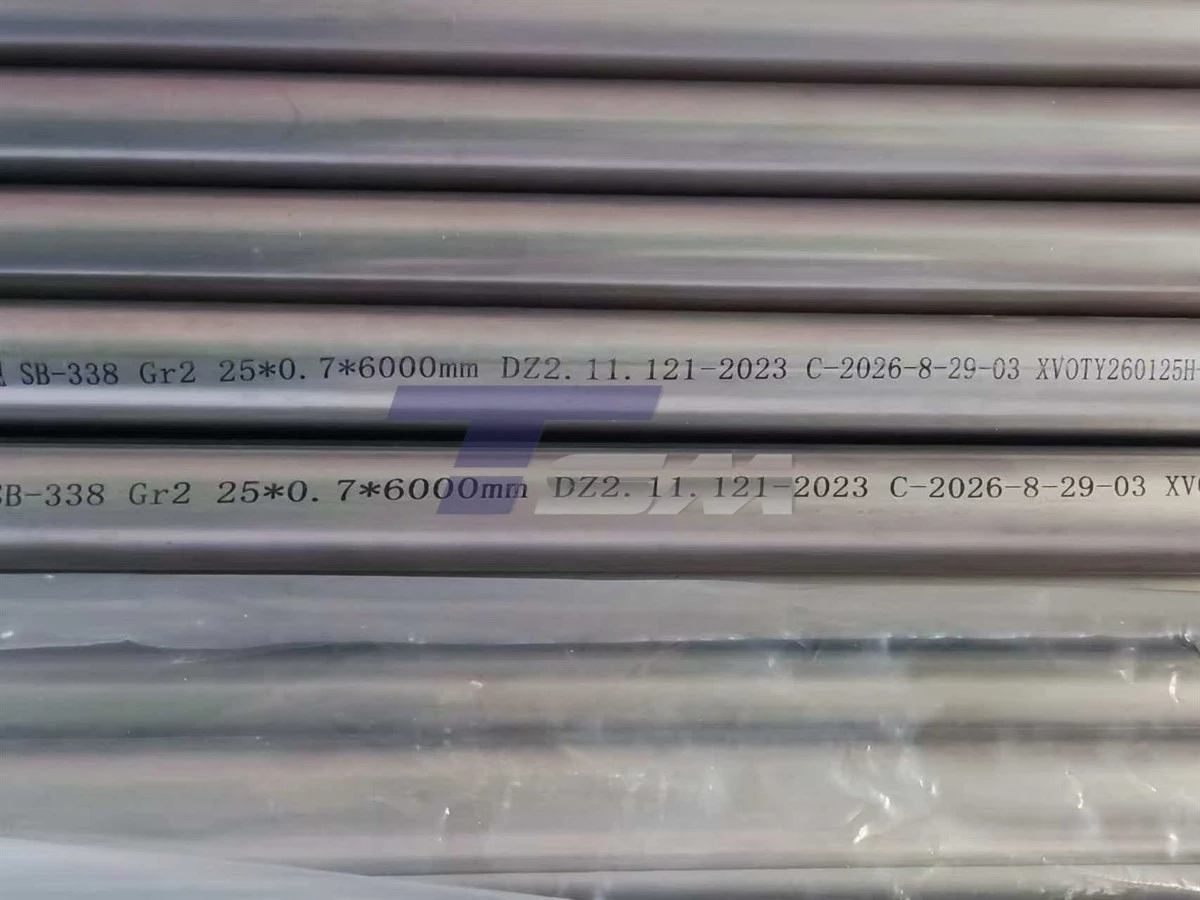
Why Is Grade 2 Titanium Used in Phosphoric Acid Processing?
Grade 2 titanium is commercially pure titanium with a useful balance of corrosion resistance, formability, and strength. Its corrosion resistance comes mainly from a thin, stable titanium oxide film that forms naturally on the metal surface.
When the film remains stable, it helps protect the underlying metal from further attack. This property makes titanium a candidate for selected chemical-processing equipment, including heat exchangers, piping, tanks, and other components that handle phosphoric acid.
However, phosphoric acid service is not automatically safe for every titanium grade or component. The actual corrosion rate depends on the complete process environment, not only the acid name on a specification sheet.
How Does Phosphoric Acid Concentration Affect Titanium Corrosion?
Phosphoric acid concentration is one of the first factors to check during material selection. Published technical references show that commercially pure titanium can resist certain phosphoric acid concentrations under controlled conditions. Its performance becomes less favorable as concentration and temperature rise.
The following values are reported in a published review of titanium corrosion. They illustrate how strongly temperature and concentration can affect corrosion. They are not TSM laboratory test results and are not guaranteed corrosion rates for every Grade 2 Titanium product.
| Phosphoric acid concentration | 35°C (mm/year) | 60°C (mm/year) | 100°C (mm/year) |
|---|---|---|---|
| 5% | 0.0033 | 0.06 | 2.36 |
| 10% | 0.005 | 0.09 | 5.00 |
| 20% | 0.015 | 0.33 | 17.40 |
| 30% | 0.018 | 1.50 | 26.40 |
The data highlights an important point: a concentration that appears manageable at a low temperature may become highly corrosive at a much higher temperature. Do not select titanium based on acid concentration alone.
Low-temperature phosphoric acid
At lower temperatures, commercially pure titanium may provide good resistance in certain phosphoric acid solutions. The published data above shows relatively low corrosion rates at 35°C across the listed concentrations. Actual performance still depends on solution chemistry, aeration, and contaminants.
Higher concentration and temperature
As temperature increases, corrosion rates can rise significantly. The reference data shows a particularly sharp increase at 100°C. Heated, concentrated, or boiling phosphoric acid therefore requires careful engineering review and testing.
The Effect of Temperature, Aeration, and Impurities
Temperature
Temperature can change titanium corrosion behavior substantially. A material that performs well in a cool storage tank may not provide the same service life in a heated process line or heat exchanger. Review the maximum operating temperature, start-up and shutdown conditions, and any local hot spots.
Aeration and oxidizing conditions
Titanium relies on a protective oxide film. Oxidizing conditions can help maintain passivity in some environments. Certain multivalent metal ions, including ferric and cupric ions, may reduce corrosion under specific conditions. Their effect depends on the full solution chemistry, so they should not be treated as a substitute for process testing.
Fluoride and other contaminants
Fluoride is one of the most important contaminants to investigate. Fluoride ions and hydrofluoric acid can attack titanium's protective oxide film and increase corrosion. Phosphoric acid produced by different processes may contain impurities that change material performance.
- Check fluoride and free hydrofluoric acid levels.
- Review chloride, sulfate, and other process contaminants where relevant.
- Consider suspended solids, deposits, and concentrated residues.
- Evaluate local conditions beneath gaskets, deposits, and other crevice-forming features.
Obtain a representative process-solution analysis before approving titanium for critical equipment.
Selecting Grade 2 Titanium Tubes for Phosphoric Acid Equipment
Grade 2 Titanium tubes may be considered for heat exchangers, condensers, piping, and other process equipment when the operating environment is suitable. Tube selection should cover more than the material grade.
- Tube type: Confirm whether the design requires seamless or welded tubes.
- Dimensions: Check outside diameter, wall thickness, and length against design pressure and mechanical requirements.
- Standard: Specify the applicable ASTM or other project standard.
- Inspection: Define the required dimensional, surface, and nondestructive examinations.
- Documentation: Confirm heat number traceability and material test documentation.
View TSM's ASTM B861 Titanium Pipe page. You can also browse our Grade 2 Titanium products.
Selecting Grade 2 Titanium Plates for Phosphoric Acid Equipment
Grade 2 titanium plates can be used to fabricate selected tanks, linings, process vessels, and equipment components. The plate specification should match both the fabrication process and the service environment.
When reviewing a plate order, consider:
- Required thickness, width, and length.
- Applicable material standard and Grade 2 chemistry requirements.
- Surface condition and flatness requirements.
- Welding, forming, and machining requirements.
- Inspection records and material traceability.
See TSM's Grade 2 Titanium Sheet page for product information and inquiry support.
How to Verify Material Suitability Before Use
Published corrosion tables are useful for screening materials, but they cannot fully reproduce every industrial process. Before finalizing a material specification, engineers should verify the actual operating environment.
- Collect process data. Record acid concentration, normal and maximum temperature, pressure, aeration, flow velocity, and expected operating cycles.
- Analyze impurities. Pay particular attention to fluoride and other contaminants that may affect titanium passivity.
- Review the equipment design. Identify crevices, weld areas, deposits, stagnant zones, and heat-transfer surfaces.
- Conduct corrosion testing. For critical service or uncertain conditions, test representative material in a solution that reflects the actual process.
- Confirm material records. Review chemical composition, mechanical properties, heat numbers, and inspection documents before fabrication.
ASTM G31 guides laboratory immersion corrosion testing of metals. Test planning should reflect the intended service conditions and the limitations of the selected method.
Frequently Asked Questions
Is Grade 2 Titanium resistant to phosphoric acid?
It can resist some phosphoric acid environments, especially under moderate conditions. Concentration, temperature, aeration, and impurities determine whether it is suitable for a specific process.
Can Grade 2 Titanium be used in hot phosphoric acid?
Do not assume it is suitable. Published data shows that corrosion can increase sharply at elevated temperatures. Review the exact concentration and temperature, then verify performance through testing.
Why is fluoride a concern in phosphoric acid service?
Fluoride ions and hydrofluoric acid can damage titanium's protective oxide film. Even a relatively small amount may change corrosion behavior, depending on the solution and operating conditions.
Are Grade 2 Titanium tubes and plates suitable for the same conditions?
The basic corrosion behavior is related to the material, but component design, fabrication, welds, surface condition, and local process conditions can affect service performance. Evaluate the complete component, not only the product form.
Can published corrosion rates be used directly for equipment design?
Use them as screening references, not as a design guarantee. Confirm the test conditions and obtain corrosion data that represents the actual process where necessary.
Need Grade 2 Titanium for Your Project?
TSM Technology supplies titanium tubes, plates, bars, forgings, fasteners, flanges, and custom-machined titanium components. Our team can help review product specifications and material documentation for your project requirements.
Send your grade, standard, dimensions, quantity, and application details to:
References
- Prando, D. et al. "Corrosion of Titanium: Part 1: Aggressive Environments and Main Forms of Degradation." Journal of Applied Biomaterials & Functional Materials, 2017.
- TIMET. Corrosion Resistance of Titanium. Technical handbook.
- Lu, J. "Corrosion of titanium in phosphoric acid at 250 °C." Transactions of Nonferrous Metals Society of China, 2009, 19(3), 552–556.
- Bäßler, R. "Recent experiences on suitability of titanium and high alloyed materials in acids at 200°C." NACE Corrosion Conference paper 5658, 2015.
- Craig, B. D. and Anderson, D. B. Handbook of Corrosion Data. ASM International, 1994.
- ASTM G31. Standard Guide for Laboratory Immersion Corrosion Testing of Metals.


