



Choosing the right ASTM B861 Titanium Pipe grade for chemical processing starts with matching the pipe material to the chemicals, temperature, pressure, and inspection requirements of the service. ASTM B861 covers seamless titanium and titanium alloy pipe for general corrosion-resisting and elevated-temperature service, with requirements for chemistry, mechanical properties, and testing. In practice, the best choice is rarely "the strongest titanium"; it is the grade that gives enough corrosion resistance, strength, fabricability, and documentation for the specific process environment.
Which ASTM B861 titanium pipe grade is best for chemical processing?
For many chemical processing systems, grade 2 titanium is the starting point because it combines strong corrosion resistance with practical availability and formability. More aggressive environments may justify Grade 7 or Grade 12, while Grade 5 titanium is usually considered when higher mechanical strength matters more than maximum corrosion resistance. The correct answer depends on what the pipe will carry, how hot the system runs, whether pressure is severe, and how much risk the plant can tolerate.
ASTM B861 includes many grades, but chemical plants often narrow the conversation to a smaller group:
- Grade 2 titanium: commercially pure titanium commonly used where corrosion resistance and ductility matter.
- Grade 7 titanium: similar to commercially pure titanium but alloyed with palladium for improved performance in more aggressive reducing or acidic conditions.
- Grade 12 titanium: a titanium alloy pipe grade containing nickel and molybdenum, often considered where crevice corrosion or difficult chloride-bearing environments are a concern.
- Grade 5 titanium: Ti-6Al-4V, a higher-strength titanium alloy that may suit pressure or structural demands but is not automatically the best corrosion choice for every chemical stream.
- Grade 2H or 7H: higher minimum tensile strength versions of familiar grades where the specification and design call for that strength level. ASTM identifies Grade 2H and Grade 7H as versions with a minimum ultimate tensile strength of 58 ksi, or 400 MPa.
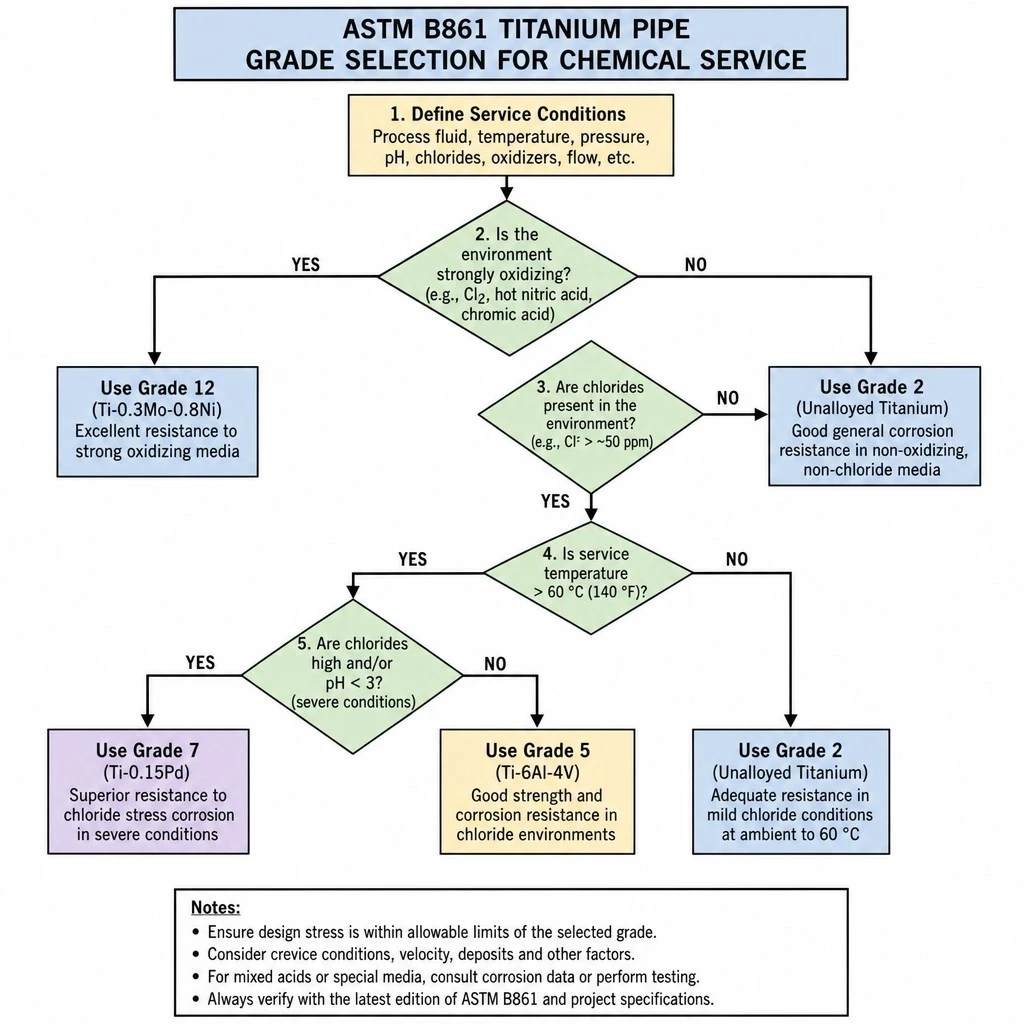
Start with the chemical environment, not the grade number
A grade number is useful only after the process conditions are understood. Before reviewing titanium pipe specifications, define the media, concentration range, operating temperature, pressure, oxygen level, contaminants, cleaning chemicals, and upset conditions. A pipe that performs well in one chloride service may not be the right choice in a hot reducing acid, and a grade selected for strength may still fail early if corrosion resistance is inadequate.
For a seawater, brine, or many oxidizing chemical environments, Grade 2 Titanium Pipe is often evaluated first because commercially pure titanium forms a stable protective oxide film in many services. Where conditions become more aggressive, especially where localized corrosion is a credible risk, Grade 7 or Grade 12 may be worth the added material cost. If the duty involves high mechanical load, vibration, or elevated pressure, Grade 5 titanium may enter the discussion, but the corrosion engineer should confirm that its alloy chemistry is suitable for the process fluid.
A practical selection sequence looks like this:
Identify the normal and abnormal chemistry. Include startup, shutdown, cleaning, contamination, and concentration swings.
Screen corrosion resistance first. Eliminate grades that are vulnerable in the actual media, even if they look attractive mechanically.
Check design strength and temperature. Confirm tensile strength, yield strength, elongation, and allowable design assumptions against the applicable code and project specification.
Review fabrication needs. Bending, joining, end preparation, and installation constraints can favor more ductile grades.
Confirm certification and testing. Require material test reports that match the purchase order, heat number, grade, size, and ASTM edition.
This order helps prevent a common procurement mistake: choosing a titanium alloy pipe because it sounds stronger, without confirming whether it is the most corrosion-resistant option for the process.
Grade 2 titanium remains the practical baseline
Grade 2 titanium is widely used because it balances corrosion resistance, ductility, weldability, and cost better than many higher-alloyed options. When engineers refer to Grade 2 Titanium Tubes or Grade 2 Titanium Pipe for chemical processing, they are usually looking for a dependable commercially pure titanium product rather than a high-strength aerospace-style alloy. That distinction matters because chemical piping is often governed by corrosion performance and long-term reliability, not just tensile strength.
In a purchasing specification, do not stop at "grade 2 titanium." Include ASTM B861, seamless pipe, nominal size or outside diameter, wall thickness or schedule, length requirements, heat treatment condition if applicable, test requirements, marking, and documentation. The more clearly the order reflects the operating service, the less room there is for mismatched supply.
Grade 2 is often a strong candidate when:
- The environment is compatible with commercially pure titanium.
- Moderate strength is sufficient for the piping design.
- Formability and installation flexibility are important.
- The plant wants a familiar, commonly specified titanium grade.
- The risk profile does not require palladium-bearing or nickel-molybdenum alloyed grades.
That said, Grade 2 is not a universal answer. If the system includes hot reducing acids, tight crevices, stagnant chlorides, or unusual contaminants, the grade selection should be reviewed by a corrosion specialist before purchase.
Higher alloyed grades solve specific problems
Grade 7, Grade 12, and Grade 5 each serve a different purpose. Grade 7 adds palladium to unalloyed titanium, and ASTM describes it as unalloyed titanium plus 0.12% to 0.25% palladium. Grade 12 is listed as titanium alloyed with 0.3% molybdenum and 0.8% nickel. Grade 5 is the familiar Ti-6Al-4V alloy, identified by ASTM as titanium alloy with 6% aluminum and 4% vanadium.
Those alloying additions are not decorative details. They influence corrosion behavior, strength, and suitability for different services. Grade 7 is typically considered where a commercially pure base is attractive but additional corrosion resistance is needed. Grade 12 can be useful where nickel and molybdenum additions help address demanding industrial environments. Grade 5 titanium, by contrast, is selected primarily for strength, so it should be checked carefully when the process chemistry is severe.
Think of the grades in terms of trade-offs:
Grade 2: broad chemical processing usefulness where corrosion conditions are suitable and strength demands are moderate.
Grade 7: an upgrade path when Grade 2 is close but the environment calls for stronger corrosion protection.
Grade 12: a candidate for difficult chloride, crevice, or mixed industrial conditions where its alloying approach is relevant.
Grade 5: a high-strength option for pressure, load, or mechanical design needs, provided corrosion compatibility is confirmed.
The best grade is the one that survives the chemistry and satisfies the mechanical design at the lowest total lifecycle risk.
What titanium pipe specifications should buyers verify?
Buyers should verify chemistry, mechanical properties, tests, dimensions, heat identity, and certification before accepting ASTM B861 material. ASTM B861 requires chemical analysis and product analysis, room-temperature mechanical properties for tensile strength, yield strength, and elongation, plus tension, flattening, bend, and hydrostatic tests. These requirements give procurement and engineering teams a shared basis for acceptance, rather than relying on a supplier description alone.
A useful material test report review should include:
Correct standard and grade: Confirm ASTM B861, the exact grade, and the referenced edition if your project specifies one.
Heat number traceability: Match the pipe markings, packing list, and mill test certificate.
Chemical composition: Check required elements and maximum limits for impurities such as oxygen, iron, nitrogen, carbon, and hydrogen where applicable.
Mechanical properties: Confirm tensile strength, yield strength, and elongation meet the grade requirements.
Required tests: Look for evidence of hydrostatic testing and the mechanical tests required by the standard and purchase order.
Dimensions: Verify outside diameter, wall thickness, length, tolerances, and end finish.
Supplementary requirements: Confirm any project-specific inspection, third-party witness, PMI, or additional documentation requirements.

The certificate should not be treated as paperwork to file after delivery. It is part of the quality system that proves the installed pipe matches the design basis.
Seamless ASTM B861 pipe and welded ASTM B862 pipe differ in risk profile
ASTM B861 applies to seamless titanium and titanium alloy pipe, while ASTM B862 applies to welded titanium and titanium alloy pipe. ASTM states that welded pipe under B862 is made from annealed flat-rolled products by a welding process. That difference in manufacturing route affects how engineers think about inspection, cost, availability, and risk in chemical processing service.
Seamless ASTM B861 Titanium Pipe has no longitudinal weld seam, which is why it is often preferred for demanding pressure, temperature, or corrosion duties. The absence of a weld seam can simplify certain reliability concerns, especially where localized attack, cyclic loading, or severe service conditions are part of the design review. Welded pipe can still be appropriate, particularly in larger sizes or less severe services, and it may offer cost or availability advantages depending on the project.
A practical way to compare them is:
Choose seamless ASTM B861 when severe corrosion, high pressure, critical safety service, or conservative reliability requirements dominate.
Consider welded ASTM B862 when the environment is compatible, inspection requirements are satisfied, and cost or size availability is a major factor.
Require clear inspection and documentation for either route, because the standard name alone does not replace engineering review.
The decision should not be framed as "seamless is always necessary" or "welded is always cheaper." It should be framed as acceptable risk for the specific process service.
A simple decision framework for chemical plants
When teams search for "How to Choose the Right ASTM B861 Titanium Pipe Grade for Chemical Processing," they are usually trying to turn a complex material question into a defendable specification. The following framework keeps the decision focused and auditable:
Define the service envelope. Document chemical media, concentration, temperature, pressure, flow, oxygen content, and upset cases.
Select candidate grades. Start with grade 2 titanium, then evaluate Grade 7, Grade 12, or grade 5 titanium only where the service conditions justify them.
Validate corrosion resistance. Use internal plant history, corrosion data, engineering judgment, and specialist review rather than assuming all titanium behaves the same.
Confirm mechanical suitability. Compare yield strength, tensile strength, elongation, and wall thickness against the piping design.
Specify the standard completely. Include ASTM B861, grade, dimensions, seamless construction, testing, marking, and certification requirements.
Review lifecycle cost. A lower initial material price can be expensive if it increases inspection burden, downtime risk, or replacement frequency.
This framework also helps align engineering, procurement, and quality teams. Engineers define the environment, procurement controls the order language, and quality verifies that the delivered pipe matches the specification.
Final takeaway
The right ASTM B861 Titanium Pipe grade is chosen by service conditions first and grade labels second. Grade 2 Titanium Pipe is often the practical baseline for chemical processing, Grade 7 and Grade 12 address more aggressive corrosion challenges, and Grade 5 titanium belongs where strength requirements justify its use and corrosion compatibility is proven. By combining clear titanium pipe specifications, careful review of titanium ASTM standards, and disciplined certification checks, chemical plants can reduce material risk and make a more confident purchasing decision.
We are here for you
To create the top brand in the field of titanium products


