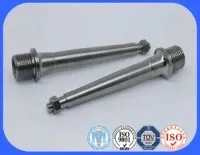
The primary differences between Grade 1 and Grade 5 titanium tubes lie in their composition, strength, ductility, and corrosion resistance. Grade 1 is commercially pure titanium with excellent ductility and formability, ideal for applications requiring extensive cold working. Grade 5 (Ti-6Al-4V) is an alpha-beta alloy strengthened with aluminum and vanadium, offering nearly three times the tensile strength but with reduced ductility. These distinct characteristics determine their suitability for various industries, from chemical processing to aerospace engineering.

1. Chemical Composition
|
Element |
Grade 1 (Commercially Pure) |
Grade 5 (Ti-6Al-4V) |
|
Titanium |
Balance (≥99.5%) |
Balance |
|
Aluminum |
- |
5.5–6.75% |
|
Vanadium |
- |
3.5–4.5% |
|
Oxygen |
≤0.18% |
≤0.20% |
|
Iron |
≤0.20% |
≤0.40% |
|
Carbon |
≤0.08% |
≤0.08% |
|
Nitrogen |
≤0.03% |
≤0.05% |
|
Hydrogen |
≤0.015% |
≤0.015% |
Key insight: The addition of aluminum (alpha stabilizer) and vanadium (beta stabilizer) in Grade 5 enables solution treating and aging, while Grade 1 relies entirely on its pure titanium matrix for properties.
2. Mechanical Properties Comparison
|
Property |
Grade 1 |
Grade 5 (Ti-6Al-4V) |
|
Tensile Strength |
240 MPa (min) |
895–1000 MPa |
|
Yield Strength (0.2% offset) |
170 MPa (min) |
825–920 MPa |
|
Elongation (break) |
24–30% |
10–15% |
|
Hardness (Brinell) |
~120 HB |
~330 HB |
|
Modulus of Elasticity |
103 GPa |
114 GPa |
|
Fatigue Strength (10⁷ cycles) |
~170 MPa |
~500 MPa |
Why this matters:
Grade 5 is approximately 3.5–4x stronger than Grade 1, making it essential for structural applications under high stress.
Grade 1 offers superior ductility, allowing easier bending, flaring, swaging, and deep drawing without cracking.
3. Physical Properties
|
Property |
Grade 1 |
Grade 5 |
|
Density (g/cm³) |
4.51 |
4.43 |
|
Melting Point (°C) |
1660 |
1604–1660 |
|
Thermal Conductivity (W/m·K) |
16.4 |
6.7 |
|
Electrical Resistivity (μΩ·m) |
0.56 |
1.78 |
|
Magnetic Properties |
Non magnetic |
Non magnetic |
Note: Grade 5's thermal conductivity is less than half that of Grade 1, which can cause heat buildup during machining or welding, requiring specialized techniques.
4. Corrosion Resistance
|
Environment |
Grade 1 |
Grade 5 |
|
Seawater (ambient) |
Excellent |
Excellent |
|
5% HCl (room temp) |
Fair |
Good |
|
10% H₂SO₄ (room temp) |
Poor |
Fair |
|
Nitric acid (oxidizing) |
Excellent |
Excellent |
|
Chloride stress corrosion |
Resistant |
Resistant |
|
High-temperature oxidation (400°C+) |
Moderate |
Good (up to 500°C) |
Both grades form a stable passive oxide film, providing outstanding resistance in seawater and chloride environments. Grade 5's aluminum content gives it a slight edge in high-temperature oxidizing atmospheres.
5. Fabrication and Weldability
|
Aspect |
Grade 1 |
Grade 5 |
|
Cold formability |
Excellent (can be deeply drawn, bent, flared) |
Poor (limited cold forming) |
|
Hot working |
Good (850–950°C) |
Excellent (900–950°C) |
|
Machinability |
Moderate (gummy, requires sharp tools) |
Poor (high tool wear, low speeds) |
|
Weldability |
Excellent (as welded strength retained) |
Good (requires post weld stress relief) |
|
Typical welding methods |
TIG, MIG, resistance |
TIG, MIG, electron beam (with inert shielding) |
TSM Technology's advantage: With 3 factories, 100+ machines, and 14+ years of experience, we offer custom cutting, bending, and welding for both grades, ensuring precision and quality.


6. Applications: Where Each Grade Excels
Grade 1 Titanium (Commercially Pure)
Chemical processing: Heat exchangers, pressure vessels, piping for mild acids
Marine engineering: Seawater cooling systems, desalination plant components
Architectural: Roofing, cladding, monuments (excellent formability)
Biomedical: Surgical instruments, dental implants (non-load-bearing)
Automotive exhaust systems: High corrosion resistance at moderate temperatures
Grade 5 Titanium (Ti-6Al-4V)
Aerospace: Airframes, landing gear, engine components, hydraulic tubing
High-performance automotive: Connecting rods, valve springs, exhaust systems
Medical implants: Hip stems, bone screws, spinal fixation devices
Oil & gas: Downhole tubing, subsea equipment, high-pressure piping
Sporting goods: Golf club heads, bicycle frames, racing wheelchairs
7. Cost Comparison
|
Factor |
Grade 1 |
Grade 5 |
|
Raw material cost |
Lower (~$8–12/kg) |
Higher (~$20–35/kg) |
|
Machining cost |
Moderate |
High (tool wear, slow speeds) |
|
Fabrication cost |
Lower (easy forming) |
Higher (specialized equipment) |
|
Overall project cost |
Economical for corrosion applications |
Premium for strength critical uses |
8. Choosing the Right Grade for Your Project – A Quick Guide
|
If you need |
Choose Grade 1 |
Choose Grade 5 |
|
Maximum corrosion resistance in seawater |
✅ |
✅ (but overkill) |
|
Easy bending, flaring, or deep drawing |
✅ |
❌ |
|
High tensile strength (>800 MPa) |
❌ |
✅ |
|
Good weldability without post-treatment |
✅ |
⚠️ (requires PWHT) |
|
Lightweight structural component |
❌ |
✅ |
|
Cost effective for large diameter pipes |
✅ |
❌ |
|
High fatigue resistance (e.g., rotating parts) |
❌ |
✅ |
9. How TSM Technology Supports Both Grades
At TSM Technology, we manufacture and supply Grade 1 and Grade 5 titanium tubes (seamless and welded), 5 titanium tubes, gr5 titanium tube, Grade 5 Titanium Seamless Tubes, titanium grade 5 seamless tube, Grade 5 seamless titanium tubing, and Gr5 titanium pipe for diverse industries. Our advantages include:
|
Feature |
Benefit |
|
3 factories, 100+ machines |
300 tons/month capacity, reliable supply |
|
ASTM/ASME/EN compliance |
Full traceability with MTC (EN 10204 3.1) |
|
Customization |
Cutting, threading, bending, welding in-house |
|
Quality |
Optional SGS inspection, hydrogen content test |
|
Delivery |
10–25 days, free samples available |
|
Payment |
T/T, L/C, flexible terms |
10. Case Study: TSM Supplies Both Grades for a Chemical Plant
A recent expansion of a chlor-alkali plant required:
Grade 1 tubes for the main seawater intake line (600 meters, 168mm OD × 3.0mm wall) – chosen for excellent formability and corrosion resistance.
Grade 5 fittings and short spools for the high-pressure chlorine feed system – required for strength and fatigue resistance.
TSM Technology provided:
Grade 1 Seamless Tubes (ASTM B861) with hydrostatic testing
Grade 5 Welded & Drawn Tubes (ASTM B862) with full radiography
Complete material traceability and third-party inspection reports
The plant has operated for 24 months without any tube-related failures.
Contact us
Choosing between Grade 1 and Grade 5 titanium tubes depends entirely on your application's balance of strength, formability, corrosion resistance, and budget. Grade 1 is the optimal choice for chemical, marine, and architectural applications where ease of forming and welding is critical. Grade 5 is the go-to material for high-stress aerospace, medical, and performance engineering applications where strength cannot be compromised.
TSM Technology offers both grades with certified quality, custom processing, and global shipping. Contact us to discuss your specific requirements.
Email: info@tsm-titanium.com
References
ASTM B861 – Standard Specification for Titanium and Titanium Alloy Seamless Pipe. ASTM International.
ASTM B862 – Standard Specification for Titanium and Titanium Alloy Welded Pipe. ASTM International.
Boyer, R., Welsch, G., & Collings, E. W. (1994). Materials Properties Handbook: Titanium Alloys. ASM International.
Donachie, M. J. (2000). Titanium: A Technical Guide. ASM International.
Leyens, C., & Peters, M. (2003). Titanium and Titanium Alloys: Fundamentals and Applications. Wiley-VCH.
Lutjering, G., & Williams, J. C. (2007). Titanium (2nd ed.). Springer.
Schutz, R. W. (2005). Titanium alloys for marine service. Corrosion: Materials, 13, 527-543.
TSM Technology Internal Product Catalog (2025).

We are always at your service when you need
TSM Technology, one of the leading Asian suppliers of high-performance titanium-based materials in China, specializes in factory-made products such as titanium tubes, welded titanium pipes and fittings, titanium flanges, titanium fasteners and nuts, titanium plates and rods, among others.
They are widely used in the construction of heat exchangers, condensers, power plants, seawater desalination facilities, oil and gas pipelines, chlor-alkali plants, and other related fields.
Number of Employees
years experience
Modern factory
Global Supply