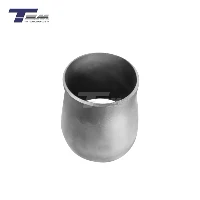
Titanium reactor vessel casting poses major challenges because molten titanium readily reacts with oxygen, nitrogen, and many mold materials. Poor process control can cause contamination, surface defects, uneven structures, and reduced mechanical performance.
For chemical processing equipment, these problems matter because material reliability affects corrosion resistance and equipment safety. Manufacturers must control melting conditions, oxygen pickup, mold temperature, solidification, and inspection.
This guide explains major challenges in titanium alloy casting and practical control methods. It also helps engineers and buyers select titanium components for chemical processing projects.
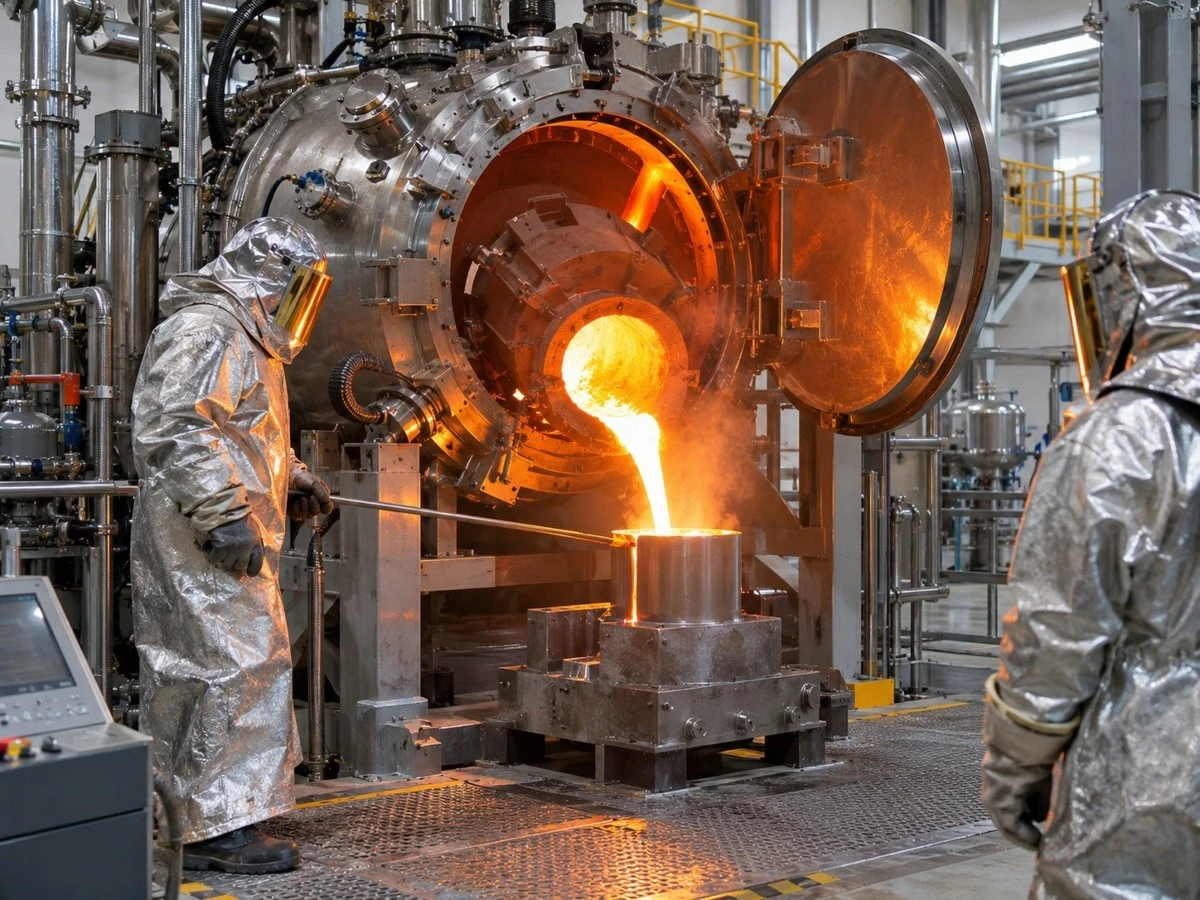
Successful titanium casting requires controlled melting, suitable mold materials, contamination control, and verified inspection results. No single melting method or preheating temperature guarantees quality.
Why Is Titanium Alloy Casting Difficult?
Titanium performs well in many corrosive chemical environments. However, molten titanium is highly reactive. It can absorb gases and react with materials that contact the liquid metal.
These reactions create several manufacturing risks:
- Oxygen and nitrogen contamination
- Reactions between molten titanium and ceramic molds
- Surface hardening and alpha-case formation
- Incomplete mold filling and shrinkage defects
- Uneven solidification and microstructural variation
- Difficulty maintaining consistent casting quality
Titanium's high melting temperature adds another challenge. Conventional casting equipment may introduce contamination or provide insufficient process control. Foundries must address these issues before an industrial component enters service.
Vacuum Melting: How Can Manufacturers Reduce Contamination?
Melting technology plays a central role in titanium casting quality. Manufacturers commonly use vacuum or controlled inert atmospheres to reduce exposure to reactive gases.
Vacuum conditions cannot prevent every contamination problem. Crucible materials, feedstock quality, and handling procedures also matter.
Vacuum Arc Remelting (VAR)
Vacuum Arc Remelting uses an electric arc to melt a consumable electrode under vacuum. The process supports titanium ingot production with controlled chemistry. Water-cooled copper equipment limits contact with reactive refractory materials.
VAR is important in titanium production, but producing an ingot is not the same as pouring a finished casting.
Vacuum Induction Melting (VIM)
Vacuum Induction Melting uses electromagnetic induction to heat metal under vacuum. VIM offers temperature control and melt mixing, but titanium's reactivity creates a challenge.
Conventional ceramic crucibles may react with molten titanium. Specialized crucibles and protective materials can reduce contamination. Their suitability depends on the alloy and melting conditions.
VIM is a possible titanium melting method, not a universal requirement.
Induction Skull Melting (ISM)
Induction Skull Melting uses a water-cooled crucible and electromagnetic heating. A solidified titanium layer helps separate molten metal from the crucible wall.
ISM can support reactive titanium alloy casting when manufacturers control the melting and pouring processes.
| Method | Main Advantage | Main Consideration |
|---|---|---|
| VAR | Controlled ingot production | Requires downstream processing |
| VIM | Melt heating and mixing control | Crucible contamination risk |
| ISM | Reduced crucible contact | Specialized equipment |
Oxygen Control: Why Does Oxygen Content Matter?
Oxygen is an interstitial element in titanium. Small changes in oxygen content can affect strength and ductility. Excess oxygen may increase hardness while reducing the metal's ability to deform.
Is an Oxygen Limit of 0.10% Always Required?
No. An oxygen content of 0.10% by weight is not a universal limit for titanium alloy castings. The permitted oxygen level depends on the grade and applicable specification.
ASTM B367 specifies requirements for titanium and titanium alloy castings. Buyers should identify the correct grade before defining chemical limits.
How Can Oxygen Contamination Be Controlled?
- Use qualified titanium feedstock with traceable chemistry.
- Keep charge materials clean and dry.
- Maintain suitable vacuum or inert atmosphere conditions.
- Use melting and mold materials compatible with titanium.
- Limit unnecessary high-temperature exposure.
- Test finished material against the required specification.
ASTM E1409 provides a recognized method for measuring oxygen and nitrogen in titanium through inert gas fusion. Buyers should request actual chemical test results.
Mold Design and Preheating: Why Is Temperature Control Important?
A suitable mold must withstand casting temperatures while limiting reactions with molten titanium. Mold design also affects how metal fills the cavity and solidifies.
Does the Mold Need Preheating to 600°C?
Some titanium investment casting processes use preheating temperatures near 600°C. However, 600°C is not a universal requirement.
The appropriate temperature depends on casting geometry, alloy chemistry, mold materials, and pouring conditions. A warmer mold can improve metal flow, but excessive heat may increase interfacial reactions.
Mold preheating does not independently prevent unwanted phase formation. Engineers must evaluate solidification and subsequent heat treatment.
Choosing Suitable Mold Materials
Many conventional casting ceramics react with molten titanium. Researchers have studied specialized refractory systems, including yttria- and zirconia-based materials.
Foundries must establish chemical compatibility and verify surface quality. Buyers should ask how suppliers control metal-mold reactions.
Alpha-Case Formation: A Critical Surface Challenge
Alpha case is an oxygen-enriched surface layer that can form when hot titanium reacts with surrounding materials. The layer may become harder and less ductile than the underlying metal.
Mold chemistry, temperature, pouring conditions, and contact time influence alpha-case formation. Manufacturers use compatible molds and controlled processes to reduce this risk.
Approved machining or surface treatment may remove affected material when necessary. Inspection must confirm that the finished casting meets the specified requirements.
Titanium Casting Quality Control Flow
Quality control begins before melting and continues through final inspection. Each step reduces the chance that defects or contamination will reach the finished component.
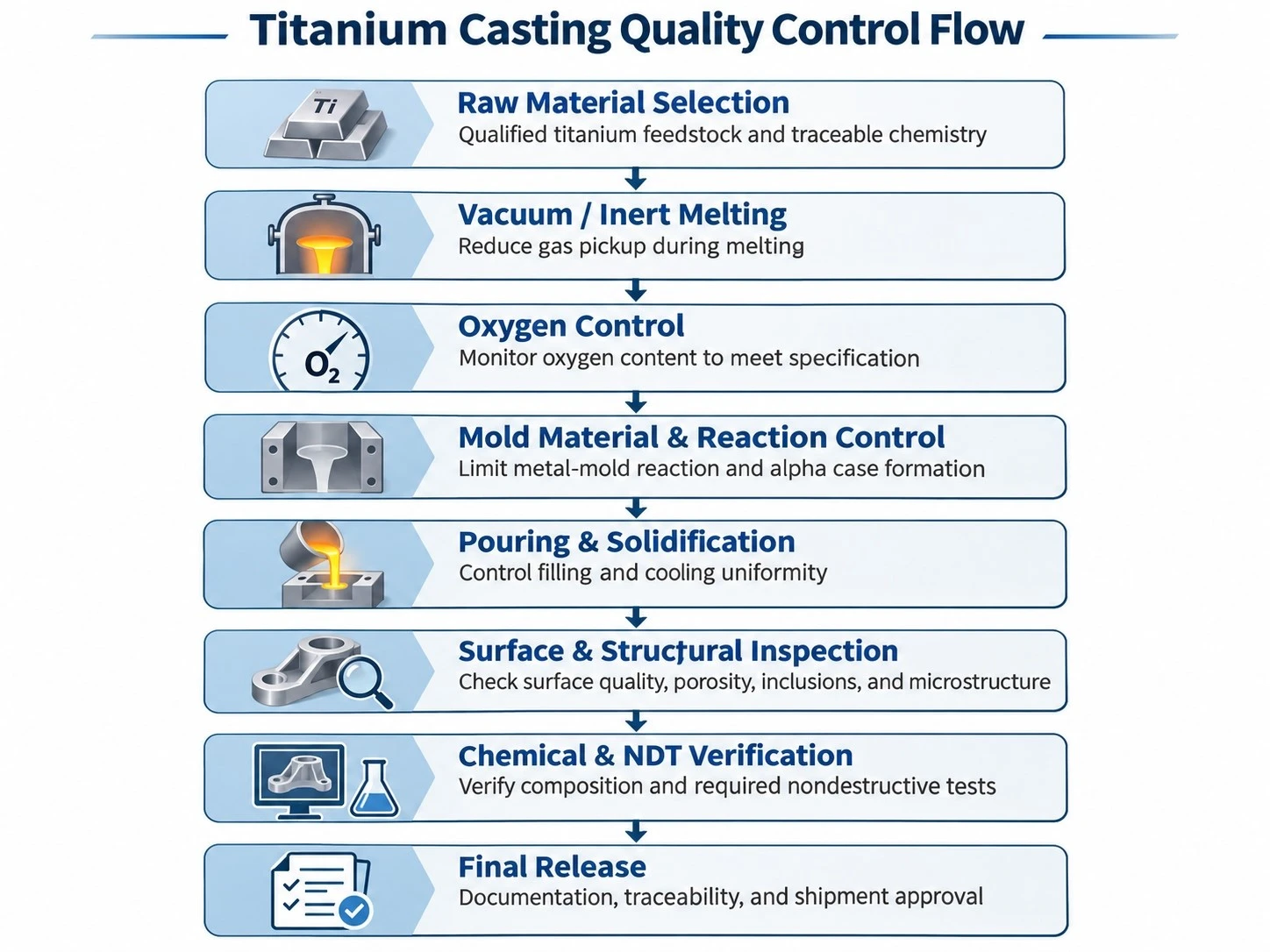
Typical process-control sequence for titanium casting, including oxygen monitoring, mold reaction prevention, and nondestructive inspection.
The flow highlights three important checkpoints: oxygen control during melting, metal-mold reaction control during casting, and inspection before release.
Common Titanium Casting Defects and Their Causes
Defects may develop during melting, pouring, solidification, or cooling. Process prevention is often more reliable than extensive repair.
| Defect | Possible Cause | Control Approach |
|---|---|---|
| Alpha case | Metal-mold reaction | Compatible molds and surface checks |
| Porosity | Gas or shrinkage | Atmosphere and feeding control |
| Incomplete filling | Premature freezing | Optimize pouring and mold conditions |
| Inclusions | Contamination or mold debris | Clean feedstock and careful handling |
| Cracking | Thermal stress | Improve geometry and cooling control |
How Can Manufacturers Maintain Uniform Microstructure?
Cooling conditions affect grain structure and phase distribution. Uneven solidification can produce different local microstructures within one casting.
Foundries must consider section thickness, thermal gradients, alloy chemistry, cooling rate, and any suitable post-casting heat treatment.
No single preheating setting guarantees uniformity. Metallographic analysis and mechanical testing can help verify critical components.
Cast Titanium or Fabricated Titanium Reactor Vessel?
Not every chemical reactor vessel needs a cast titanium body. Many industrial vessels use formed titanium plate, welded shells, and separately manufactured components.
Casting may suit complex parts, while plate fabrication often suits shells and large formed structures. Equipment design, pressure requirements, inspection access, and costs affect the choice.
| Consideration | Casting | Plate Fabrication |
|---|---|---|
| Typical suitability | Complex components | Shells and formed structures |
| Key concern | Casting defects | Weld integrity and forming |
| Inspection focus | Casting integrity | Material and weld quality |
Engineers must also consider corrosion behavior, design pressure, temperature, and applicable vessel codes.
Quality Standards and Inspection Requirements
Buyers should verify chemical composition, material condition, dimensions, traceability, and inspection records. Common references include:
- ASTM B367: Titanium and titanium alloy castings.
- ASTM B265: Titanium sheet, strip, and plate.
- ASTM E1409: Oxygen and nitrogen measurement in titanium.
- ASME BPVC Section VIII: Pressure vessel design and construction, when applicable.
Required inspections may include radiography, ultrasound, surface examination, or mechanical tests. The purchase specification should identify acceptance criteria before production.
What Should B2B Buyers Ask Their Titanium Supplier?
- Which titanium grade matches the operating conditions?
- Does the project require a casting, forging, or fabricated component?
- Which ASTM or ASME requirements apply?
- What chemical and mechanical test reports are available?
- Which nondestructive inspections does the design require?
- Can the supplier provide heat-number traceability?
- What machining allowances and tolerances apply?
For cast components, ask about mold reactions and casting defects. For fabricated reactor shells, focus on plate quality, welding procedures, and pressure vessel compliance.
Titanium Materials for Chemical Equipment From TSM Technology
At TSM Technology, we supply titanium materials for industrial and chemical processing applications.
Our product range includes titanium plates, tubes, bars, forgings, flanges, and machined components. Our team can review your specifications, drawings, dimensions, and documentation needs before quotation.
Buyers should confirm separate casting capabilities and component acceptance requirements for any cast reactor parts.
Frequently Asked Questions
Why Does Titanium Casting Require Vacuum or Inert Gas?
Molten titanium reacts readily with atmospheric gases. Vacuum or inert protection helps limit contamination during melting and casting.
Is VIM Better Than VAR for Titanium Casting?
Neither method is universally better. VAR supports ingot production, while specialized VIM offers induction heating and mixing. The application determines the process.
What Causes Alpha Case in Titanium Castings?
Alpha case results from reactions involving hot titanium and its surroundings. Mold chemistry, temperature, and contact time influence its formation.
Is 600°C the Standard Mold Preheating Temperature?
No. Some processes use temperatures near 600°C, but every casting process needs qualified conditions.
Which Standard Applies to Titanium Alloy Castings?
ASTM B367 is a key casting specification. Other requirements may apply to the finished equipment.
Need Titanium Materials for Chemical Reactor Equipment?
Titanium casting quality depends on careful material selection, manufacturing control, and inspection. Choosing the correct product form is equally important.
Contact TSM Technology about titanium plates, tubes, forgings, and machined components for your project. Share your material grade, drawings, quantity, and standards.
Request a QuotationEmail: info@tsm-titanium.com
References
- ASTM International. ASTM B367: Standard Specification for Titanium and Titanium Alloy Castings.
- ASTM International. ASTM E1409: Standard Test Method for Determination of Oxygen and Nitrogen in Titanium and Titanium Alloys by Inert Gas Fusion.
- ASTM International. ASTM B265: Standard Specification for Titanium and Titanium Alloy Strip, Sheet, and Plate.
- ASME. Boiler and Pressure Vessel Code, Section VIII: Rules for Construction of Pressure Vessels.
- ASM International. ASM Handbook, Volume 15: Casting.
- TIMET (Titanium Metals Corporation). Titanium Design and Fabrication Handbook.