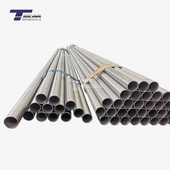
Selecting the appropriate titanium pipe for your specific application requires careful consideration of multiple factors-from material grade and manufacturing standards to operational requirements and environmental conditions. At TSM TECHNOLOGY CO., LTD, we specialize in providing high-performance titanium piping solutions that meet the most demanding industrial requirements while ensuring long-term reliability and cost efficiency.

Understanding Titanium Pipe Fundamentals
Titanium pipes offer an exceptional combination of properties that make them ideal for challenging applications across various industries. Their low density (approximately 60% that of steel), excellent corrosion resistance, and high strength-to-weight ratio make them particularly valuable in applications where weight savings, corrosion resistance, and durability are critical factors.
The natural oxide layer that forms on titanium surfaces provides outstanding protection against corrosive environments, including chloride-containing solutions, acidic and alkaline media, and seawater. This corrosion resistance translates to extended service life and reduced maintenance costs, making titanium pipes ideal for chemical processing, marine engineering, and offshore applications.
Key Selection Criteria for Titanium Pipes
1. Material Grade Selection
Choosing the appropriate titanium grade is fundamental to ensuring optimal performance in your specific application:
Grade 1 (UNS R50250): Offers the highest ductility and excellent welding characteristics. Ideal for corrosion applications where forming is required.
Grade 2 (UNS R50400): The most widely used commercial pure titanium grade. Provides an excellent balance of strength, ductility, and corrosion resistance.
Grade 5 (Ti-6Al-4V, UNS R56400): An alpha-beta alloy offering higher strength than commercial pure grades while maintaining good corrosion resistance.
Grade 9 (Ti-3Al-2.5V, UNS R56320): Offers improved strength over commercial pure grades with excellent welding and forming characteristics.
Table: Titanium Grade Selection Guide
| Grade | Tensile Strength (MPa) | Yield Strength (MPa) | Primary Applications | |
|---|---|---|---|---|
| Grade 1 | 240 | 170 | Chemical processing, marine components | |
| Grade 2 | 345 | 275 | Heat exchangers, piping systems | |
| Grade 5 | 895 | 825 | Aerospace, high-strength components | |
| Grade 9 | 620 | 483 |
Aerospace tubing, hydraulic systems |
2. Understanding Pressure Ratings and Standards
Pressure rating is a critical consideration for titanium pipes, especially in applications such as aerospace hydraulics (35 MPa systems) and industrial processing. Several key standards govern titanium pipe manufacturing:
ASTM B338: Standard specification for seamless and welded titanium and titanium alloy tubes.
ASTM B861: Standard for titanium and titanium alloy welded pipe.
ASTM B862: Standard for titanium and titanium alloy seamless pipe.
ASME SB338: ASME's adoption of ASTM B338 for pressure vessel applications.
ISO 18487-1: Aerospace standard for titanium tubes intended for 35 MPa operating pressure systems.
These standards ensure that titanium pipes meet specific requirements for chemical composition, mechanical properties, dimensional tolerances, and testing procedures.
3. Manufacturing Process: Ti Seamless vs. Welded
The manufacturing process significantly impacts titanium pipe performance characteristics:
Seamless pipes : Manufactured through extrusion or piercing processes, offering uniform structure and better pressure containment capability. Ideal for high-pressure applications.
Welded pipes : Formed from plate or strip that is rolled and welded longitudinally. More cost-effective for large diameters and suitable for many corrosion-resistant applications.
4. Size and Dimensional Considerations
Titanium pipes are available in a wide range of sizes to meet various application requirements:
Outer diameter: Ranging from small diameters (6 mm) for instrumentation applications to large diameters (530 mm) for industrial processing systems.
Wall thickness: Governed by schedule numbers (Sch 5S, 10S, 40S, 80S) or direct thickness specifications, with typical ranges from 0.5 mm to 20 mm.
Length: Standard lengths typically range from 3000 mm to 12000 mm, with custom lengths available.
Titanium Pipe Applications Across Industries
Aerospace Engineering
In aerospace applications, titanium pipes are essential for hydraulic systems, fuel lines, and environmental control systems. Their high strength-to-weight ratio and excellent fatigue resistance make them ideal for aircraft applications where weight reduction is critical. The ISO 18487-1 standard specifically addresses titanium tubes for aerospace applications with operating pressures up to 35 MPa.
Chemical Processing
Titanium pipes demonstrate exceptional resistance to a wide range of corrosive chemicals, including chlorides, oxidizing acids, and alkaline solutions. This makes them valuable in chemical processing plants where stainless steels would rapidly deteriorate.
Marine and Offshore
The superior seawater corrosion resistance of titanium pipes makes them ideal for marine applications, including:
Shipboard piping systems
Heat exchangers and condensers
Desalination plants
Offshore platform components
Power Generation
Titanium pipes are widely used in power plants for condenser tubes and heat exchanger applications, particularly in coastal locations where seawater cooling is utilized. Their resistance to biofouling and corrosion immunity in seawater provide significant advantages over traditional materials.
Comparative Analysis: Titanium vs. Other Materials
Table: Titanium vs. Alternative Materials
| Property | Titanium | Stainless Steel 316 | Copper-Nickel 70/30 | Aluminum |
|---|---|---|---|---|
| Density (g/cm³) | 4.51 | 8.0 | 8.95 | 2.7 |
| Tensile Strength (MPa) | 345-1380 | 515-690 | 300-380 | 90-310 |
| Corrosion Resistance | Excellent | Good | Very Good | Fair to Good |
| Life in Seawater | 60+ years | 10-15 years | 15-25 years | 5-8 years |
| Thermal Conductivity | Low | Moderate | High | High |
| Cost Factor | High | Moderate | High | Low |
When comparing titanium to stainless steel, titanium demonstrates superior corrosion resistance in chloride environments and offers a significantly longer service life in aggressive media. While the initial cost is higher, the life-cycle cost of titanium pipes is often lower due to reduced maintenance and replacement requirements.
Maintenance Tips for Titanium Pipe Systems
Proper maintenance ensures long-term performance and reliability of titanium piping systems:
Regular Inspection: Conduct periodic visual inspections for signs of mechanical damage, erosion, or foreign object impact.
Cleaning Procedures: Use appropriate cleaning methods compatible with titanium. Avoid abrasive cleaners that might damage the protective oxide layer.
Corrosion Monitoring: While highly corrosion-resistant, monitor for any unusual conditions that might affect performance.
Gasket and Seal Maintenance: Regularly inspect and replace gaskets and seals to prevent leaks, particularly in flanged connections.
Documentation Review: Maintain records of installation, maintenance activities, and any system modifications for future reference.
How to Identify Authentic Titanium Pipes
With the premium cost of titanium pipes, ensuring material authenticity is crucial:
Visual Inspection: Titanium has a distinctive dark gray metallic appearance when unprocessed and develops a light gray hue after processing.
Weight Assessment: Titanium is significantly lighter than steel (approximately 56% of the weight) but heavier than aluminum.
Spark Test: When grinded, titanium produces bright white sparks-distinct from the red-orange sparks of steel.
Chemical Test: A small drop of nitric acid on titanium will not produce a reaction (due to the passive oxide layer), while it would corrode many other metals.
Certification Documentation: Always request mill test certificates (MTC) or certificates of conformity that verify material composition and compliance with relevant standards.
ASTM vs. ASME Standards: Understanding the Difference
The relationship between ASTM and ASME standards often causes confusion:
ASTM (American Society for Testing and Materials): Develops material specifications and test methods. ASTM standards (e.g., ASTM B338) define chemical, mechanical, and dimensional requirements.
ASME (American Society of Mechanical Engineers): Adapts ASTM standards for pressure application use. ASME standards (e.g., ASME SB338) incorporate ASTM specifications but add requirements for pressure application, including more stringent testing and certification.
For pressure applications, ASME standards are typically required, while ASTM standards suffice for non-pressure applications.
Why Choose TSM TECHNOLOGY CO., LTD for Your Titanium Pipe Needs?
At TSM TECHNOLOGY CO., LTD, we bring extensive expertise in titanium pipe manufacturing and application engineering. Our capabilities include:
Comprehensive Material Selection: Offering a wide range of titanium grades to meet specific application requirements.
Precision Manufacturing: Utilizing state-of-the-art processes to ensure dimensional accuracy and performance consistency.
Quality Assurance: Implementing rigorous testing protocols including hydrostatic testing, ultrasonic examination, and eddy current testing.
Technical Support: Providing expert guidance on material selection, system design, and installation best practices.
Custom Solutions: Developing tailored solutions for unique application challenges, including special sizes, shapes, and configurations.
Our titanium pipes comply with international standards including ASTM, ASME, ISO, and GB/T specifications, ensuring global acceptance and performance reliability.

Conclusion: Making the Right Choice for Your Application
Selecting the appropriate titanium pipe requires careful consideration of operating conditions, performance requirements, and economic factors. By understanding the key selection criteria-including material grade, manufacturing standard, size dimensions, and pressure rating-you can make an informed decision that optimizes both performance and life-cycle cost.
The exceptional properties of titanium pipes-including outstanding corrosion resistance, high strength-to-weight ratio, and long-term durability-make them a valuable solution for demanding applications across aerospace, chemical processing, marine, and power generation industries.
Contact TSM TECHNOLOGY CO., LTD today to discuss your specific titanium pipe requirements. Our technical experts will help you navigate the selection process and identify the optimal solution for your application challenges.