


Grade 7 Titanium (Ti-0.2Pd): High-Performance Corrosion Solutions
TSM Technology, a high-tech titanium materials manufacturer headquartered in Shaanxi, China, focuses on producing and distributing Grade 7 titanium (UNS R52400) worldwide. Grade 7 titanium is designed for high-reliability applications in corrosive environments, making it the material of choice for chemical processing infrastructure, particularly suitable for scenarios with extremely high requirements for gap stability and cathodic protection.
Our Grade 7 titanium production process uses advanced vacuum arc melting (VAR), ensuring a uniform distribution of palladium (Pd) content from 0.12% to 0.25% in the titanium alloy. This alloying ratio significantly enhances the material's resistance to crevice corrosion and pitting corrosion, especially in acidic brine and high-temperature chloride solutions. TSM Technology offers a vertically integrated supply chain covering the full range of products from raw material ingots to precision-machined finished components.
What is Grade 7 Titanium? The Palladium Advantage
Grade 7 titanium alloy is microalloyed by adding 0.12% to 0.25% palladium to commercial pure titanium. The addition of palladium acts as a cathode modifier, promoting spontaneous passivation in weakly reducing environments and preventing the destruction of the natural titanium oxide film. This makes Grade 7 titanium the preferred material for handling dilute hydrochloric acid, sulfuric acid, and hot brine solutions, which can cause pitting or crevice corrosion in pure titanium.
Why can such a small amount of palladium (Pd) fundamentally alter the alloy's properties?
The answer lies in cathode modification, with titanium grade 7 achieved through a transformation of 0.12-0.25% palladium (Pd).
In reducing acids (HCl, H2SO4), standard titanium's protective TiO2 layer dissolves, causing the metal to become "active" and corrode. Palladium, a noble metal with extremely low hydrogen overpotential, fundamentally alters this electrochemical behavior:
1. Catalytic Sites: Pd acts as a cathodic catalyst, accelerating the Hydrogen Evolution Reaction (2H + 2e -> H2).
2. Potential Shift: This increased cathodic activity shifts the alloy's corrosion potential (Ecorr) in the noble (positive) direction.
3. Spontaneous Passivation: This shift forces the potential above the Flade Potential, the threshold required to maintain the TiO2 film.
In practical applications, Grade 7 is often selected for systems where Grade 2 may experience localized corrosion over long-term exposure.
TSM Technology Supply Capabilities: Titanium Grade 7 Product Forms

Standard: ASTM B265 / ASME SB265 Thickness: 0.5mm to 100mm Ideal for reactor linings and large vessel construction.

Standard: ASTM B348 / ASME SB348 Diameter: 3mm to 400mm Precision ground or rough turned for CNC machining applications.

Standard: ASTM B338 / B861 Seamless and welded options. Essential for heat exchangers and high-pressure piping.

Standard: ASTM B381 Flanges, rings, and custom shapes. High-integrity components for extreme pressure environments.

Standard: AWS A5.16 (Filler Metal) Diameter: 0.1mm to 5mm Used as weld wire (ERTi-7) or for spring and filter mesh applications.

Complete system components including elbows, tees, and high-purity Titanium Flange
Grade 7 Titanium Technical Specifications
Chemical Composition
The precision of the palladium content is what defines the quality of titanium Grade 7. Below is the chemical breakdown required for compliance with international standards.
| Element | Pd | N | C | H | Fe | O | Ti |
| Weight % (max unless range) | 0.12 - 0.25 | 0.03 | 0.08 | 0.015 | 0.30 | 0.25 | Balance |
Mechanical Performance
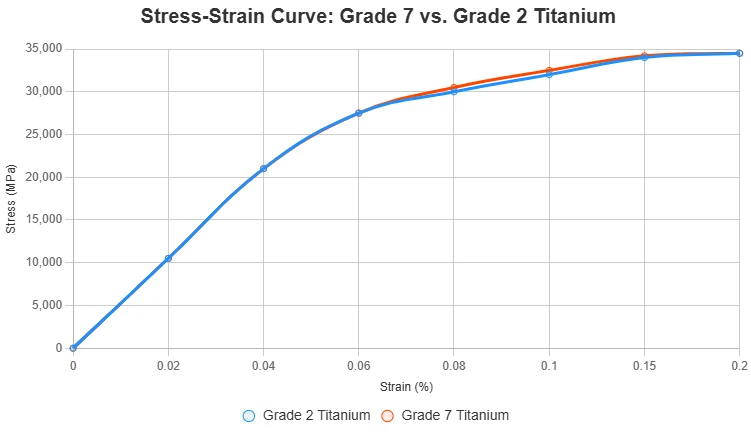
Mechanically, Grade 7 is comparable to Grade 2, providing a balanced profile of strength and high ductility for complex fabrication.
| Property | Minimum Value |
| Tensile Strength | 345 MPa (50,000 psi) |
| Yield Strength (0.2% offset) | 275 MPa (40,000 psi) |
| Elongation in 2 inches (50mm) | 20% |
| Reduction of Area | 30% |
Physical Constants
These physical properties are essential for engineers calculating weight, thermal expansion, and heat transfer efficiency in equipment design.
| Property | Value |
| Density | 4.51 g/cm³ (0.163 lb/in³) |
| Melting Range | 1670 °C (3040 °F) |
| Thermal Conductivity | 16.4 W/m-K (114 BTU-in/h-ft²-°F) |
| Coefficient of Thermal Expansion | 8.6 µm/m-°C (4.8 µin/in-°F) |
| Modulus of Elasticity | 105 GPa (15.2 x 10³ ksi) |
Grade 7 titanium machining
Welding Considerations (ERTi-7)
Grade 7 offers excellent weldability. However, the use of ERTi-7 filler metal is mandatory to ensure the weld bead matches the palladium content of the base material. Gas Tungsten Arc Welding (GTAW) is preferred, with a strict requirement for high-purity argon shielding to prevent oxygen embrittlement.
Machining & Formability
Due to its high ductility, titanium Grade 7 can be cold-formed similarly to mild steel. When machining, low cutting speeds and heavy feed rates are recommended to minimize work hardening. Continuous cooling with high-quality lubricants is essential for maintaining tool life and surface finish.
Surface Treatment
Annealed Grade 7 usually arrives with a descaled or pickled finish. For extreme service, electropolishing can further enhance the protective oxide layer, providing an even higher degree of resistance in pharmaceutical and high-purity chemical environments.
Grade 7 vs Grade 2 Titanium
For many engineers, the choice between Grade 7 vs Grade 2 titanium comes down to the chemical environment. While Grade 2 is the 'workhorse' of the industry due to its cost-effectiveness, it struggles in reducing acids and environments where crevice corrosion is a threat. Grade 7 Titanium, through its palladium-stabilized matrix, provides the ultimate insurance against equipment failure in these aggressive zones.
| Property | Grade 2 Titanium | Grade 7 Titanium |
|---|---|---|
| Palladium Content | 0% | 0.12–0.25% |
| Corrosion Resistance | Excellent | Superior, resistant to nitric, sulfuric, and phosphoric acids |
| Tensile Strength | 340–550 MPa | 480–690 MPa |
| Applications | General industry | Chemical processing, marine, aerospace |
| Cost | Lower | Higher |
Corrosion Resistance
Grade 7 Titanium is ideal for highly corrosive environments, including:
Oxidizing acids (nitric, sulfuric, phosphoric)
Chloride-containing solutions and seawater
Aggressive chemical reactors and piping systems
Its corrosion resistance is significantly better than Grade 2 Titanium, ensuring longer service life in extreme conditions.
Want to know more details on Grade 2 Titanium?
Critical Applications of Titanium Grade 7
The unique ability of Grade 7 Titanium to resist localized corrosion in reducing environments makes it a multi-industry staple. At TSM Technology, we serve several key sectors:
1. Chemical Processing: Reactor autoclaves, piping systems, and heat exchangers handling chlorine, bromides, and mineral acids.
2. Desalination & Marine: Brine concentrators and evaporators where high chloride levels at elevated temperatures would cause pitting in lower grades.
3. Oil & Gas: Offshore platforms and subsea equipment exposed to sour gas (H2S) and high-temperature CO2 environments.
4. Pharmaceuticals: Equipment requiring strict non-toxic, sterile, and chemically stable surfaces for sterile drug production.

5. Chlor-Alkali Industry
Grade 7 titanium is widely used in chlor-alkali plants because it offers excellent resistance to wet chlorine, brine, and chloride-rich chemicals. The alloy is commonly used for electrolyzers, brine heaters, piping systems, and heat exchangers, helping extend equipment service life in highly corrosive environments.
6. Heat Exchangers
Grade 7 titanium is an ideal material for heat exchangers handling acidic or chloride-containing fluids. Its excellent corrosion resistance, stable thermal performance, and long service life make it widely used in condenser tubes and shell-and-tube heat exchangers.
7. Acid Pickling Equipment
In acid pickling systems, Grade 7 titanium provides outstanding resistance to hydrochloric acid and sulfuric acid environments. It is commonly used in pickling tanks, acid piping, heating coils, and pump components where strong corrosion resistance is required.
8. Marine Engineering
Grade 7 titanium is widely used in marine engineering because of its superior resistance to seawater corrosion and biofouling. Common applications include marine heat exchangers, shipboard cooling systems, condenser tubing, and seawater piping systems requiring long-term durability.
Key Benefits of Grade 7 Titanium
Outstanding crevice corrosion resistance
01
Excellent chloride resistance
02
Suitable for acidic environments
03
High weldability
04
Long service life in seawater systems
05
Why Choose TSM Technology?
As a premier manufacturer and supplier, TSM TECHNOLOGY CO offers more than just metal. We provide technical consulting, global logistics, and certified material quality.
•Inventory Depth: We maintain a large stock of Grade 7 Titanium plates, bars, and tubes for immediate dispatch.
•Custom Fabrication: Our CNC machining and forging centers can produce complex parts to your exact drawings.
•Certified Quality: Every shipment includes full Mill Test Certificates (EN 10204 3.1) and ultrasonic testing results.
•Competitive Pricing: Direct-from-factory pricing on one of the market's most expensive and specialized alloys.

FAQ
Q1: Is Grade 7 titanium better than Grade 2?
A1: Yes, Grade 7 offers superior corrosion resistance and higher tensile strength.
Q2: Can Grade 7 titanium resist sulfuric and phosphoric acids?
A2: Yes, the palladium enhancement allows Grade 7 titanium to perform excellently in these acidic environments.
Q3: Is Grade 7 titanium weldable?
A3: Yes, it can be welded using standard titanium welding techniques, including TIG and laser welding.
Q4: What ASTM standards apply to Grade 7 titanium?
A4: Common standards include ASTM B265 for sheet, strip, and plate, and ASTM B338 for seamless tubes.
Contact Us:
For expert guidance on selecting Titanium Grade 7, contact TSM Technology. Our technical team is ready to support your project with professional titanium solutions.
Email: info@tsm-titanium.com

We are always at your service when you need
TSM Technology, one of the leading Asian suppliers of high-performance titanium-based materials in China, specializes in factory-made products such as titanium tubes, welded titanium pipes and fittings, titanium flanges, titanium fasteners and nuts, titanium plates and rods, among others.
They are widely used in the construction of heat exchangers, condensers, power plants, seawater desalination facilities, oil and gas pipelines, chlor-alkali plants, and other related fields.
Number of Employees
years experience
Modern factory
Global Supply
We are here for you
To create the top brand in the field of titanium products


