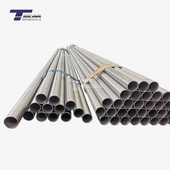
Chemical processing and industrial equipment often operate in highly corrosive environments, making proper material selection essential to prevent equipment failure, unexpected downtime, contamination, and high maintenance costs. Hastelloy C276 (UNS N10276), a nickel-chromium-molybdenum alloy, offers excellent resistance to aggressive oxidizing and reducing acids, while 316L stainless steel has more limited performance in strong acids and chloride-rich conditions. This comparison helps engineers and procurement managers choose the right material for demanding applications.

Chemical Composition Comparison
|
Element |
Hastelloy C276 (%) |
316L Stainless Steel (%) |
Notes |
|
Nickel (Ni) |
Balance |
10–14 |
Provides general corrosion resistance |
|
Chromium (Cr) |
15–17 |
16–18 |
Oxidation protection |
|
Molybdenum (Mo) |
15–17 |
2–3 |
Enhances pitting/crevice corrosion resistance |
|
Iron (Fe) |
4–7 |
Balance |
Structural component |
|
Cobalt (Co) |
3–7 |
- |
Improves resistance in oxidizing media |
|
Carbon (C) |
≤0.03 |
≤0.03 |
Low carbon reduces carbide precipitation |
Analysis:
C276 has higher nickel and molybdenum content, giving it superior corrosion resistance compared to 316L.
Mechanical Properties
|
Property |
C276 |
316L SS |
Notes |
|
Tensile Strength |
≥485 MPa |
485–620 MPa |
Similar, but C276 has better ductility |
|
Yield Strength |
≥205 MPa |
170–290 MPa |
Comparable |
|
Elongation |
≥30% |
40% |
C276 maintains strength in acidic media |
|
Hardness |
≤95 HRB |
90 HRB |
Slightly harder alloy |
|
Density |
8.9 g/cm³ |
8 g/cm³ |
Heavier alloy |
Corrosion Resistance Comparison
|
Environment |
C276 |
316L SS |
Recommendation |
|
Sulfuric Acid |
Excellent |
Fair |
Use C276 for concentrated acid |
|
Hydrochloric Acid |
Excellent |
Poor |
C276 required |
|
Nitric Acid |
Excellent |
Good |
C276 preferred for oxidizing conditions |
|
Phosphoric Acid |
Excellent |
Good |
C276 recommended |
|
Chloride Solutions |
Excellent |
Fair |
C276 preferred for chloride-rich media |
|
Mixed Acid Systems |
Excellent |
Fair |
C276 ensures long-term durability |
Key Takeaway:
Hastelloy C276 is superior in all aggressive chemical and mixed acid environments.
Applications
Hastelloy C276 Tubes
High-concentration sulfuric and hydrochloric acid piping
Heat exchangers and evaporators
Reactor tubes
Industrial chemical processing systems
316L Stainless Steel Tubes
Mild acid piping
Low-corrosion process streams
Cooling and HVAC applications
Non-critical chemical transfer lines
Application Table
|
Application |
C276 Tube |
316L SS Tube |
Recommendation |
|
Sulfuric acid pipelines |
Excellent |
Fair |
C276 |
|
Hydrochloric acid |
Excellent |
Poor |
C276 only |
|
Heat exchanger tubing |
Excellent |
Good |
C276 preferred |
|
Low-concentration acid |
Good |
Excellent |
316L acceptable |
Advantages of C276 over 316L
|
Feature |
C276 |
316L SS |
|
Pitting Resistance |
Excellent |
Fair |
|
Crevice Corrosion |
Excellent |
Fair |
|
Oxidizing Acid Resistance |
Excellent |
Moderate |
|
Reducing Acid Resistance |
Excellent |
Good |
|
Lifecycle Cost |
Lower (long-term) |
Higher (short-term) |
|
Maintenance |
Minimal |
Frequent inspections required |
Purchasing Considerations
ASTM B622 compliance for seamless tubes
UNS N10276 certification
EN 10204 3.1 Mill Test Certificate
PMI verification and hydrostatic testing
Dimensional inspection and traceability
Reliable suppliers like TSM Technology provide certified C276 tubes with full testing documentation and custom sizing.
FAQ
Q1: Can 316L SS replace C276 in chemical plants?
A1: Only for mild, low-corrosion environments. C276 is required for strong oxidizing or reducing acids.
Q2: What is the UNS number of C276?
A2: UNS N10276.
Q3: Are C276 tubes weldable?
A3: Yes, proper welding procedures maintain corrosion resistance.
Q4: Which industries use C276 tubes?
A4: Chemical processing, heat exchangers, phosphoric acid plants, sulfuric acid systems, offshore and marine applications.
Q5: Are both seamless and welded tubes available?
A5: Yes. Seamless is preferred for high-pressure, high-purity applications.
Conclusion
Hastelloy C276 tubes provide superior corrosion resistance and reliability compared with 316L stainless steel in most chemical and industrial applications. While 316L may be cost-effective for mild conditions, C276 is the material of choice for aggressive acids, chlorides, and mixed chemical environments, ensuring long service life, low maintenance, and process safety.
We are here for you
To create the top brand in the field of titanium products