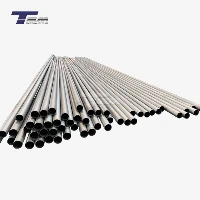
Choosing between Grade 2 Titanium and stainless steel 316L is an important decision for equipment exposed to seawater. Both materials resist corrosion in many industrial environments. However, their performance differs when chloride ions, temperature, and stagnant water affect the metal surface.
Grade 2 titanium offers excellent resistance to seawater corrosion and chloride-induced localized attack. Stainless steel 316L provides good general corrosion resistance but can suffer pitting and crevice corrosion in seawater.
For marine heat exchangers, desalination systems, and seawater piping, these differences affect maintenance costs and equipment reliability.
This guide compares corrosion mechanisms, service conditions, applications, and material selection factors. It will help you choose a suitable material for your project.
Grade 2 titanium generally offers better resistance to localized corrosion in natural seawater than 316L stainless steel. However, the best choice depends on temperature, water chemistry, equipment design, and total lifecycle cost.
What Are Grade 2 Titanium and Stainless Steel 316L?
Both materials form protective oxide films that help resist corrosion. Their chemical compositions and mechanical properties are different.
Grade 2 Titanium (UNS R50400)
Grade 2 is commercially pure titanium with controlled levels of oxygen, iron, and other residual elements.
It combines good ductility, moderate strength, and excellent corrosion resistance. Its surface forms a stable titanium oxide film that protects the underlying metal.
Engineers frequently consider Grade 2 for seawater equipment, chemical processing systems, and corrosion-resistant heat exchangers.
Stainless Steel 316L (UNS S31603)
316L is an austenitic stainless steel containing chromium, nickel, and molybdenum.
Chromium supports the protective passive film, while molybdenum improves resistance to localized corrosion compared with common 304 stainless steel.
The letter L indicates low carbon content. This helps reduce sensitization and related intergranular corrosion risks during welding.
However, low carbon content does not eliminate chloride pitting or crevice corrosion.
Grade 2 Titanium vs 316L Stainless Steel: Key Differences
The following comparison highlights important material properties and seawater corrosion behavior.
| Property | Grade 2 Titanium | 316L Stainless Steel |
|---|---|---|
| UNS Designation | R50400 | S31603 |
| Density | Approx. 4.51 g/cm3 | Approx. 8.0 g/cm3 |
| Protective Film | Titanium oxide | Chromium-rich oxide |
| General Seawater Corrosion | Excellent resistance | Often low under passive conditions |
| Pitting Resistance | Excellent in typical seawater | Susceptible in seawater |
| Crevice Corrosion | Strong resistance in ordinary seawater | Significant localized corrosion risk |
| Material Cost | Generally higher | Generally lower |
| Typical Marine Use | Seawater-contact heat transfer equipment | Selected components under controlled conditions |
Note: Corrosion behavior depends on actual service conditions. This table provides general selection guidance rather than guaranteed service performance.
Why Does Grade 2 Titanium Resist Seawater Corrosion?
Titanium develops a thin oxide layer when exposed to suitable environments.
This passive film strongly limits corrosion and can reform after surface damage when local conditions support repassivation.
The film remains highly stable in many chloride-containing environments, including natural seawater.
This gives titanium an important advantage over conventional stainless steels in demanding marine service.
Resistance to Chloride-Induced Pitting
Chloride ions can promote localized corrosion when a protective metal surface film breaks down.
Grade 2 titanium shows excellent resistance to pitting in typical natural seawater conditions.
Its passive film offers strong protection even when seawater contains high chloride concentrations.
This makes Grade 2 attractive for long-term seawater-contact equipment where localized corrosion could cause leakage.
Resistance to Flowing Seawater
Titanium also performs well in many flowing seawater applications.
Its stable surface film helps resist erosion-corrosion under suitable operating conditions.
This property supports its use in condensers, cooling systems, and marine heat exchangers.
However, abrasive particles, vibration, and mechanical damage still require engineering evaluation.
Why Can 316L Stainless Steel Corrode in Seawater?
316L stainless steel performs well in many industrial environments. However, natural seawater creates conditions that can trigger localized corrosion.
Chloride exposure, deposits, stagnant water, and unfavorable crevice geometry increase the risk.
Pitting Corrosion
Pitting creates small, localized cavities in a metal surface.
Chloride ions can damage the passive film on 316L stainless steel. Once a pit forms, local chemical conditions may support continued corrosion.
A component may appear undamaged across most of its surface while deep pits develop in isolated areas.
This creates a potential leakage risk in thin-walled tubes and other pressure-containing components.
Crevice Corrosion
Crevice corrosion can occur beneath gaskets, deposits, washers, and tightly fitted metal surfaces.
Restricted water exchange changes the local chemistry inside the crevice.
316L is particularly vulnerable when chloride-rich seawater remains trapped in these locations.
The British Stainless Steel Association identifies pitting and crevice corrosion as important failure mechanisms for 316 stainless steel in seawater.
Does 316L Have Better Corrosion Resistance Than 316?
Not necessarily in seawater.
The low carbon content of 316L helps reduce sensitization-related corrosion in welded components.
However, this improvement does not make 316L immune to chloride pitting or crevice corrosion.
Both 316 and 316L require careful selection for seawater service.
How Do Temperature, Flow, and Stagnation Affect Corrosion?
Seawater conditions are not identical across different projects.
Engineers should examine temperature, flow velocity, oxygen levels, and deposits before choosing a material.
Seawater Temperature
Higher temperatures generally increase localized corrosion risks for 316L.
Grade 2 titanium performs well across many ordinary seawater temperatures. However, severe crevice conditions can affect its performance at elevated temperatures.
Some published technical data report strong Grade 2 crevice corrosion resistance below approximately 80°C.
This value should not serve as a universal design limit. Actual susceptibility depends on local chemistry and crevice geometry.
Hot, low-oxygen, or unusual seawater environments require more detailed assessment.
Stagnant Seawater
Stagnant seawater can increase the risk of localized attack on stainless steel.
Deposits and biological growth can create shielded areas where corrosive conditions develop.
For 316L systems, proper drainage and controlled operating conditions are important.
Grade 2 titanium provides better resistance in many stagnant seawater applications, although fouling can still affect equipment performance.
Flow Velocity and Biofouling
Water flow influences deposit formation, heat transfer, and local corrosion conditions.
Sufficient flow can help reduce deposits in certain stainless steel systems.
Titanium resists many erosion-corrosion conditions, but marine organisms can still attach to its surface.
Equipment designers must consider cleaning procedures and fouling control regardless of material choice.
Typical Seawater Applications of Grade 2 Titanium
Grade 2 titanium is commonly considered for industrial equipment requiring reliable long-term contact with seawater.
Marine Heat Exchangers and Condensers
Heat exchangers transfer thermal energy between fluids through metal surfaces.
Seawater-contact tubes must resist corrosion while supporting heat-transfer performance.
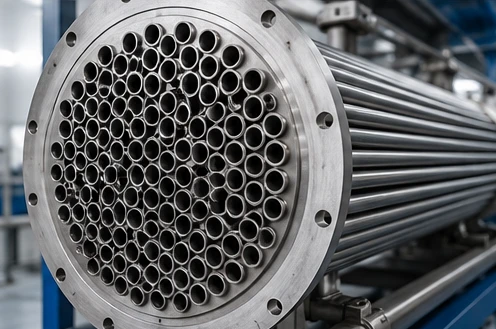
Grade 2 titanium tubing offers strong resistance to localized corrosion, making it attractive for marine cooling equipment.
Designers must still account for tube dimensions, heat transfer, pressure, vibration, and inspection requirements.
Desalination Equipment
Desalination systems use seawater and concentrated salt solutions under different operating conditions.
Grade 2 titanium can support corrosion-resistant heat-transfer components in suitable desalination processes.
The final grade depends on temperature, brine concentration, and equipment design.
Seawater Cooling and Offshore Equipment
Marine systems also require corrosion-resistant piping, fittings, and structural components.
Titanium offers low density and excellent resistance to many ordinary seawater conditions.
These properties support long-service equipment where maintenance access is difficult.
Explore our Titanium for Marine and Seawater Applications resource for further material selection guidance.
Grade 2 Titanium vs 316L: Which Material Should You Choose?
Grade 2 titanium is not automatically necessary for every marine component.
316L may remain suitable for selected applications where exposure is limited and engineers can control service conditions.
For continuously wetted seawater systems, Grade 2 often provides a stronger corrosion-resistance margin.
| Application Condition | Material to Consider | Selection Reason |
|---|---|---|
| Continuous natural seawater exposure | Grade 2 Titanium | Strong localized corrosion resistance |
| Marine heat exchanger tubing | Grade 2 Titanium | Reliable seawater-contact performance |
| Short, controlled seawater exposure | Evaluate 316L | Lower initial material cost |
| Hot seawater with tight crevices | Detailed alloy evaluation | Elevated localized corrosion risk |
| Weight-sensitive marine component | Grade 2 Titanium | Lower material density |
These guidelines do not replace application-specific corrosion assessments or engineering calculations.
Consider Total Lifecycle Cost
316L generally has a lower initial material cost than Grade 2 titanium.
However, material price is only one part of project cost.
Engineers should also consider maintenance, inspection, downtime, repair, and replacement costs.
Grade 2 may provide better lifecycle value when corrosion-related failures would cause expensive equipment shutdowns.
A complete cost comparison should use actual quotations and realistic service assumptions.
ASTM Standards and B2B Purchasing Requirements
Material selection must include the correct product standard.
For Grade 2 titanium, common standards vary by material form.
| Standard | Product Form |
|---|---|
| ASTM B338 | Titanium condenser and heat exchanger tubes |
| ASTM B861 | Seamless titanium pipe |
| ASTM B862 | Welded titanium pipe |
| ASTM B265 | Titanium sheet and plate |
| ASTM A240/A240M | 316L stainless steel plate and sheet |
Before ordering, confirm the exact dimensions, product form, material grade, and applicable standard edition.
A purchasing checklist should include:
- Material grade and UNS designation
- Applicable ASTM or ASME specification
- Dimensions and manufacturing tolerances
- Required surface condition
- Mill test report and chemical composition
- Mechanical testing and inspection requirements
- Heat-number traceability
- Delivery quantity and packaging requirements
You can explore additional specifications through the TSM Titanium Standards Resource.
Source Grade 2 Titanium From TSM Technology
At TSM Technology, we manufacture and supply titanium materials for industrial, marine, and engineering applications.
Our product range includes titanium tubes, plates, bars, forgings, flanges, fasteners, and machined components.
We support customers with material specifications, dimensional requirements, and inspection documentation.
For seawater projects, our team can review your required titanium grade, product form, and manufacturing specifications.
Explore available Grade 2 Titanium Products for your application.
Frequently Asked Questions
Is Grade 2 Titanium Better Than 316L in Seawater?
Grade 2 generally provides better resistance to pitting and crevice corrosion in natural seawater. However, material selection still depends on operating conditions.
Can 316L Stainless Steel Be Used in Seawater?
Yes, in selected applications with controlled exposure and suitable design. Continuous immersion, stagnation, and crevice conditions can increase corrosion risks.
Does Grade 2 Titanium Corrode in Hot Seawater?
Grade 2 offers excellent corrosion resistance, but severe high-temperature crevice environments can cause localized attack. Evaluate the actual conditions before selection.
Why Is Grade 2 Used for Seawater Heat Exchangers?
Its stable oxide film provides strong resistance to seawater corrosion. This helps protect thin-walled heat exchanger tubes against localized corrosion.
Is Grade 2 Titanium More Expensive Than 316L?
Grade 2 titanium generally costs more initially. However, corrosion resistance and potential maintenance savings can improve its value over the equipment lifecycle.
Looking for Grade 2 Titanium for Seawater Applications?
Choosing the right corrosion-resistant material can improve equipment reliability and reduce maintenance risks.
TSM Technology supplies Grade 2 titanium materials for industrial and marine applications.
Send us your required material grade, dimensions, quantity, applicable standard, and project conditions.
Request a Grade 2 Titanium QuotationEmail: info@tsm-titanium.com
References
- British Stainless Steel Association. Selection of 316, 304 and 303 Types of Stainless Steels for Seawater Applications.
- Alleima. Alleima Ti Grade 2: Seamless Tube and Pipe Technical Datasheet.
- International Titanium Association. Titanium for Desalination Applications.
- ASTM International. ASTM B338: Standard Specification for Seamless and Welded Titanium and Titanium Alloy Tubes for Condensers and Heat Exchangers.
- ASTM International. ASTM B265: Standard Specification for Titanium and Titanium Alloy Strip, Sheet, and Plate.
- Nature Portfolio, npj Materials Degradation. A Comparison Study of Crevice Corrosion on Typical Stainless Steels Under Biofouling and Artificial Configurations. 2022.