


For procurement officers and frame engineers, understanding the metallurgical nuances of Grade 9 titanium tubing is critical. It is not merely a middle ground between commercially pure titanium and high-strength Grade 5; it is a specialized alloy designed specifically for the rigors of thin-walled, high-pressure, and high-vibration applications.
What is Grade 9 Titanium (Ti-3Al-2.5V)?
Grade 9 titanium is an alpha-beta alloy containing 3% aluminum and 2.5% vanadium. Often referred to as "half-6-4" due to its relationship with the more common Grade 5 (6% Al, 4% V), Grade 9 was originally developed for aerospace hydraulic lines.
In the context of titanium bicycle frame tubes, Grade 9 offers a unique combination of cold-workability and high strength. While Grade 5 is significantly stronger, it is extremely difficult to draw into thin-walled seamless tubes. Grade 9, however, can be cold-worked to achieve mechanical properties that far exceed Grade 2, making it the industry standard for titanium tubes for bicycles.
Mechanical Performance: Why Grade 9 Wins
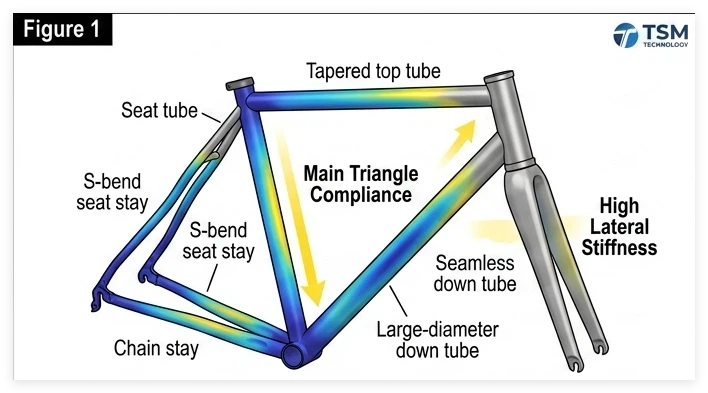
The primary reason for choosing grade 9 titanium tubing as the bicycle frame material is its superior strength-to-weight ratio and fatigue resistance.A bicycle frame undergoes millions of stress cycles during its lifespan; Grade 9 provides the "compliance" (dampening) needed for rider comfort without sacrificing the "stiffness" required for power transfer.
Comparative Mechanical Properties
The following table compares Grade 9 against other common frame materials:
| Material Property | Grade 9 Titanium (CWSR) | Grade 2 Titanium | 6061 Aluminum | 4130 Chromoly Steel |
| Tensile Strength (MPa) | 700 - 900 | 345 - 500 | 310 | 560 - 700 |
| Yield Strength (MPa) | 600 - 750 | 275 - 450 | 275 | 460 |
| Elongation (%) | 12 - 15 | 20 | 12 - 17 | 15 - 20 |
| Density (g/cm³) | 4.48 | 4.51 | 2.70 | 7.85 |
| Modulus of Elasticity (GPa) | 100 - 105 | 103 | 69 | 205 |
Note: CWSR refers to Cold Worked Stress Relieved, the state in which most Grade 9 titanium tubing is supplied for frame building.
The Advantages of Seamless Grade 9 Titanium Tubing
When sourcing titanium tubes for bicycles, the manufacturing process-seamless versus welded-is a non-negotiable quality factor.
Seamless Integration
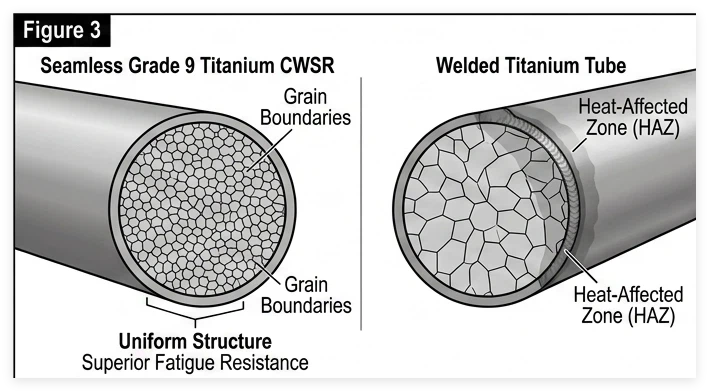
High-performance frames require seamless Grade 9 titanium tubes. Seamless tubing is manufactured through a rotary piercing or extrusion process, followed by multiple stages of cold reduction (pilgering). This ensures:
Uniformity: No weld seam means no localized "heat-affected zone" that could serve as a failure point.
Precision: Tighter tolerances on wall thickness and outside diameter (OD).
Surface Finish: A superior internal and external finish, reducing the risk of stress risers.
Fatigue Life and Vibration Dampening
One of titanium's legendary traits is its "road feel." Because Grade 9 has a lower modulus of elasticity than steel, it acts as a natural shock absorber. This reduces rider fatigue over long distances. Unlike aluminum, which has a finite fatigue life (it will eventually crack), titanium has a defined fatigue limit. If the stresses remain below this limit, the frame can theoretically last forever.
Key Applications in Bicycle Frame Anatomy
A modern bicycle frame is a complex assembly of different tube profiles. Grade 9 titanium tubing is utilized across various sections, often with varying wall thicknesses to optimize weight.
The Down Tube and Top Tube
The down tube is the "backbone" of the frame, requiring the largest diameter Grade 9 titanium pipe to resist torsional forces. Top tubes are often tapered or ovalized to balance lateral stiffness with vertical compliance.
Stay Tubing (Seat Stays and Chain Stays)
These are often smaller diameter tubes (typically 12.7mm to 19mm). The ability to manipulate Grade 9-such as "S-bending" for tire clearance-makes it ideal for these complex geometries.
Butted vs. Plain Gauge Tubing
For elite-tier frames, manufacturers use double-butted titanium bicycle frame tubes. "Butting" involves making the tube walls thicker at the ends (where welding occurs) and thinner in the middle (where stress is lower). This can reduce frame weight by up to 15% without compromising structural integrity.

Technical Challenges: Welding and Fabrication
While Grade 9 titanium tube offers immense benefits, it demands rigorous fabrication standards. Titanium is highly reactive to oxygen at high temperatures.
Shielding Gas: Welding must be performed in an inert atmosphere, typically using ultra-pure Argon gas. Any contamination leads to embrittlement, visible as straw-colored or blue discoloration.
TIG Welding: Tungsten Inert Gas (TIG) welding is the gold standard. The welder must ensure "back-purging" (filling the inside of the tube with argon) to protect the interior of the joint.
Machining: Titanium's low thermal conductivity and high galling tendency require sharp tools and specific coolant strategies when mitering the tubes.
Sourcing and Standards (B2B Procurement)
For industrial buyers and bicycle brands, verifying compliance with international standards is the only way to ensure safety.
Relevant ASTM Standards
ASTM B338: Seamless and welded titanium and titanium alloy tubes for condensers and heat exchangers (the most common standard for bike tubing).
ASTM B861: Standard specification for titanium and titanium alloy seamless pipe.
AMS 4943/4944: Aerospace specifications for Grade 9 hydraulic tubing, often cited for the highest-performance applications.
Quality Control Checklist for Procurement
When ordering Grade 9 titanium tubing from a supplier like TSM Technology, ensure the following documentation is provided:
MTC (Material Test Certificate): Validating the chemical heat analysis and mechanical test results.
Ultrasonic Testing (UT): To detect internal flaws or cracks in the tube wall.
Dimensional Inspection: Ensuring OD, ID, and wall thickness (WT) meet the ± tolerances required for precision mitering.
Comparative Analysis: Titanium vs. Carbon vs. Steel
To understand the market position of titanium tubes for bicycles, we must look at the competition.
Grade 9 Titanium vs. Carbon Fiber
Carbon fiber is lighter and can be molded into aerodynamic shapes. However, it is susceptible to impact damage and catastrophic failure. Grade 9 titanium tubing is incredibly resilient; it doesn't shatter upon impact and is resistant to scratches and "frame pump" wear.
Grade 9 Titanium vs. Grade 5 Titanium
While Grade 5 (Ti-6Al-4V) is stronger, its ductility is much lower. Using Grade 5 for the entire frame would result in an overly harsh ride. Furthermore, Grade 5 is rarely available in seamless tube form; most "Grade 5 tubes" are actually seam-welded from sheet metal, which is less desirable for high-performance cycling.
Sustainability and Lifecycle Value
From a long-term perspective, the total cost of ownership (TCO) of Grade 9 titanium alloy tubing is lower than that of almost any other material.
Corrosion Resistance: Titanium forms a stable oxide layer. It doesn't rust like steel or corrode like aluminum. It is unaffected by salt water and sweat, making it ideal for all-weather gravel and road bikes.
Recyclability: Titanium is 100% recyclable, aligning with modern "green supply chain" initiatives.
The Future of Grade 9 in Cycling
As the cycling industry shifts toward gravel racing and "adventure" riding, the demand for Grade 9 titanium tubing continues to grow. Its ability to survive harsh environments while providing a refined riding experience is unmatched.
For manufacturers, the success of a titanium product line depends on the quality of the raw material. Selecting high-precision, seamless Grade 9 titanium tubes ensures that the final frame meets the rigorous safety standards (EN/ISO) and the high expectations of the enthusiast market.
Please click to discuss your project further with our experienced engineers.


