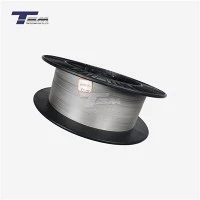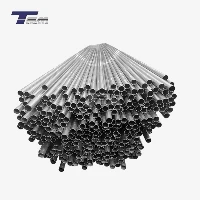
Grade 2 titanium tubes are widely used in chemical processing, marine engineering, heat exchangers, power generation, and other industrial applications. Its combination of corrosion resistance, moderate strength, formability, and weldability makes it a practical material for equipment operating in demanding environments.
However, the quality of a finished titanium tube depends on much more than the chemical composition of the raw material. Every manufacturing stage-from titanium sponge melting and ingot preparation to tube forming, cold working, heat treatment, and final inspection-can influence dimensional accuracy, mechanical properties, surface quality, and service reliability.

So, how is a Grade 2 Titanium tube manufactured? This article explains the main production stages of seamless Grade 2 Titanium tube, describes the purpose of each process, and shows how manufacturers control quality from the initial ingot to the finished product.
Manufacturing Process at a Glance
The table below summarizes the main stages of Grade 2 Titanium tube production. Each stage is explained in more detail in the sections that follow.
| Stage | Purpose | Key Control Points |
|---|---|---|
| 1. Raw material & melting | Titanium sponge to ingot via vacuum melting (e.g., VAR) | Chemistry and interstitial content (O, N, H, C, Fe), homogeneity, traceability |
| 2. Billet preparation | Forging, breakdown, machining, UT | Cast structure breakdown, surface condition, internal soundness |
| 3. Hot extrusion | Form the hollow tube shell | Temperature, lubrication, deformation rate, surface condition |
| 4. Cold pilgering | Reduce OD and wall thickness; improve precision and finish | Pass schedule, intermediate annealing, dimensional consistency |
| 5. Heat treatment | Achieve required material condition (e.g., annealing) | Temperature, holding time, atmosphere, cooling |
| 6. Straightening & finishing | Straightening, cutting, pickling / polishing | Straightness, cut quality, surface cleanliness |
| 7. Inspection | Verify chemistry, mechanical properties, dimensions, NDT | Test scope per standard, documentation, traceability |
1. Raw Material Preparation: From Titanium Sponge to Ingot
The manufacturing process begins with titanium sponge, which is the primary raw material used in conventional titanium production.
Titanium sponge is selected and prepared according to the required material grade. Its chemical composition must be controlled because elements such as oxygen, nitrogen, hydrogen, carbon, and iron can influence the mechanical properties and processing behavior of commercially pure titanium.
For Grade 2 Titanium, controlling interstitial elements is particularly important. Oxygen, for example, contributes to strength but can also reduce ductility when its content becomes too high.
Vacuum Melting
Prepared titanium sponge and approved titanium scrap may be blended according to the production requirements. The material is then melted in a vacuum environment to reduce contamination and achieve a uniform chemical composition.
Vacuum Arc Remelting (VAR) is one established method used in titanium ingot production. During this process, an electric arc melts the consumable electrode under vacuum, and the molten titanium solidifies in a water-cooled copper mold.
The resulting ingot provides the starting material for subsequent forging and tube production.
Why Ingot Quality Matters
Ingot quality affects the consistency of every downstream manufacturing operation. Important control points include:
- Chemical composition and interstitial element content
- Material homogeneity
- Internal soundness and potential defects
- Traceability of the melting batch
- Surface condition before further processing
A well-controlled melting process provides a more reliable foundation for producing Grade 2 Titanium tubes with consistent properties.
2. Billet Preparation: Forging and Machining
After melting, the titanium ingot is not normally ready for direct tube production. It must first be processed into a suitable billet or intermediate workpiece.
Forging and Breakdown Processing
The ingot is heated within a suitable processing temperature range and subjected to forging or other breakdown operations. These operations reduce the original ingot cross-section and prepare the material for subsequent tube-forming processes.
Forging helps break down the cast structure and improve material uniformity. The actual forging schedule depends on the ingot size, equipment, required billet dimensions, and material condition.
Billet Machining
After forging, the billet may undergo surface conditioning and machining. Typical operations include:
- Removing surface irregularities and defective areas
- Turning the billet to the required dimensions
- Preparing the billet for piercing or extrusion
- Checking surface condition and dimensional accuracy
For seamless tube production, billet preparation is especially important because defects in the starting material may affect the quality of the finished tube.
Ultrasonic Testing
Ultrasonic Testing (UT) can be used to examine the billet for internal discontinuities before further processing.
Early detection helps reduce the risk of carrying internal defects into later manufacturing stages. The inspection method and acceptance criteria should follow the applicable specification or agreed quality plan.
3. Hot Extrusion: Forming the Hollow Tube Shell
Hot extrusion is one of the important manufacturing routes for producing seamless titanium tubes.
In this process, a prepared titanium billet is heated to a suitable temperature and forced through a die. A mandrel or piercing arrangement helps form the internal opening, producing a hollow tube shell.
The extrusion temperature, tooling design, lubrication, deformation rate, and equipment condition all influence the quality of the extruded shell.
Key Process Controls
Several factors require attention during hot extrusion:
- Temperature control: Titanium must be processed within a suitable temperature range. Excessive or insufficient heating can affect deformation behavior and product quality.
- Lubrication and surface protection: Appropriate lubrication helps reduce friction between the billet and tooling. TSM's published manufacturing information describes the use of lubricated glass powder during its hot extrusion process.
- Deformation control: The extrusion ratio and processing conditions should be suitable for the billet and required tube dimensions.
- Surface condition: The extruded shell should be checked for surface defects and irregularities before further reduction.
Hot extrusion transforms the prepared billet into a hollow shell, creating the basic tubular form for subsequent processing.
4. Cold Pilgering: Reducing Diameter and Wall Thickness
After hot extrusion, the hollow shell usually requires additional processing to achieve the final dimensions and surface condition.
Cold pilgering is an important process in seamless Grade 2 Titanium tube production. It progressively reduces the outside diameter and wall thickness while controlling the tube's dimensions.
During cold pilgering, the tube passes through a pilger mill equipped with specially shaped rolls and a mandrel. The rolls move back and forth while the tube is fed and rotated in controlled increments. This repeated deformation gradually changes the tube dimensions.
Why Is Cold Pilgering Important?
Cold pilgering offers several manufacturing advantages:
- More precise control of outside diameter and wall thickness
- Improved dimensional consistency
- Better surface finish compared with the preceding hot-formed condition
- Ability to produce smaller-diameter and thinner-wall tubes
- Controlled deformation for achieving the required product condition
The number of pilgering passes depends on the initial shell dimensions and the required finished dimensions.
Intermediate Annealing
Titanium becomes harder as it undergoes repeated cold deformation. If deformation continues without suitable process control, forming resistance increases and the risk of cracking may rise.
Intermediate annealing is therefore used when required between cold-working passes. The purpose is to restore suitable ductility and reduce the effects of accumulated cold work, allowing the tube to undergo further reduction.
The annealing temperature, holding time, cooling method, and atmosphere must be selected according to the material, dimensions, and production requirements.
5. Heat Treatment: Achieving the Required Material Condition
After the main forming and cold-working operations, Grade 2 Titanium tubes may undergo final heat treatment.
Annealing is commonly used to obtain the required material condition and improve ductility after cold working.
The heat-treatment procedure must be appropriate for the applicable product standard and customer specification. It should not be treated as a universal fixed-temperature operation for every tube size and manufacturing route.
Important Heat-Treatment Considerations
- Temperature and holding time: These parameters influence the final material condition and must be controlled according to the production procedure.
- Atmosphere protection: Titanium reacts readily with oxygen and other gases at elevated temperatures. A suitable furnace atmosphere and process arrangement help limit surface contamination.
- Cooling conditions: Cooling must follow the specified heat-treatment procedure.
- Surface condition: Any oxidation or surface contamination should be evaluated before the next finishing operation.
Correct heat treatment helps ensure that the finished Grade 2 Titanium tube meets the required mechanical and metallurgical condition.
6. Straightening, Cutting, and Surface Finishing
After heat treatment, the tube proceeds to final dimensional and surface processing.
Straightening
Straightening corrects deviations in tube alignment caused by forming, cold working, or heat treatment. The straightness requirement depends on the product standard, tube dimensions, length, and customer specification.
Cutting to Length
Tubes are cut to the specified delivery length. Cutting operations should avoid excessive deformation, burrs, or damage to the tube ends. The ends may be deburred or otherwise finished according to the purchase requirements.
Surface Treatment
Surface finishing is selected according to the intended application and product specification. Common finishing options may include:
- Pickling
- Mechanical polishing
- Bright or specially controlled surface finishing
- Other customized surface treatments
Pickling can remove surface scale and certain contaminants formed during high-temperature processing. Polishing may be required where a particular surface appearance or finish is specified.
The appropriate finishing method depends on the tube's manufacturing condition and final application.
7. Quality Inspection: Verifying the Finished Grade 2 Titanium Tube
Manufacturing is not complete when the tube reaches its final dimensions. Inspection is necessary to verify that the product meets the applicable technical requirements.
For Grade 2 Titanium tube, quality control generally covers material identity, chemical composition, mechanical properties, dimensions, surface condition, and specified non-destructive examinations.
Chemical Composition Analysis
Chemical analysis verifies that the material meets the composition requirements for Grade 2 Titanium. Elements commonly controlled include:
- Nitrogen
- Carbon
- Hydrogen
- Iron
- Oxygen
The applicable limits should be checked against the governing product standard and its current edition.
Mechanical Testing
Mechanical testing evaluates whether the tube meets the required material properties. Depending on the product standard and purchase specification, testing may include:
- Tensile testing
- Flattening testing
- Flaring testing
- Bend testing
- Hardness testing, where specified
The required tests and acceptance criteria depend on the product form and applicable standard.
Non-Destructive Testing (NDT)
Non-destructive testing helps identify discontinuities without damaging the finished product. Common methods include:
- Ultrasonic Testing (UT): Used to detect internal or subsurface discontinuities, depending on the inspection setup.
- Eddy Current Testing (ET): Used for detecting certain surface and near-surface discontinuities in conductive tubing.
- Hydrostatic Testing: Used where required to verify pressure integrity and leakage resistance.
Not every test applies to every Grade 2 Titanium tube. The inspection plan should be based on the applicable ASTM specification, product type, and customer requirements.
Dimensional and Surface Inspection
Final dimensional inspection may include:
- Outside diameter
- Inside diameter, where required
- Wall thickness
- Length
- Straightness
- Ovality
- Surface condition
These measurements help confirm that the finished tube meets the drawing and purchase specification.
Documentation and Traceability
Material traceability is also an important part of quality assurance. A finished tube should be linked to its original material heat or batch through appropriate identification and records. Depending on the order requirements, documentation may include:
- Mill Test Report (MTR)
- Chemical composition results
- Mechanical test results
- NDT reports
- Dimensional inspection records
- EN 10204 3.1 documentation, where specified
Third-party inspection can also be arranged when required by the customer or project.
8. Seamless vs Welded Grade 2 Titanium Tube: Are the Processes Different?
Yes. Seamless and welded Grade 2 Titanium tubes use different forming and joining routes.
A seamless tube is produced from billet through processes such as hot extrusion or piercing, followed by rolling, pilgering, drawing, or other reduction operations.
A welded tube generally starts with flat-rolled titanium strip. The strip is slit to the required width, progressively formed into a tubular shape, and joined along a longitudinal seam. The weld area may then undergo bead finishing, heat treatment, and inspection according to the applicable specification.
Main Differences Between Seamless and Welded Tube
| Manufacturing Stage | Seamless Tube | Welded Tube |
|---|---|---|
| Starting material | Titanium billet or hollow billet | Titanium strip or flat-rolled material |
| Tube formation | Piercing, extrusion, or related hollow-forming process | Roll forming |
| Joining | No longitudinal weld seam | Longitudinal welding |
| Size reduction | Hot working and cold pilgering or drawing | Sizing and other specified processing |
| Quality focus | Material integrity, dimensions, and surface quality | Base material quality plus weld integrity and weld-zone condition |
Neither manufacturing route is automatically suitable for every application. Buyers should confirm the required product form and standard before placing an order.
9. Which Standard Applies to Grade 2 Titanium Tube?
The applicable standard depends on the product form and intended service.
- ASTM B861 covers seamless titanium and titanium alloy pipe. Grade 2 is included in its scope as UNS R50400.
- ASTM B862 covers welded titanium and titanium alloy pipe.
- ASTM B338 covers seamless and welded titanium and titanium alloy tubes for condensers and heat exchangers.
These standards should not be treated as interchangeable. The buyer should identify whether the required product is pipe or heat-exchanger tubing and specify the applicable standard in the purchase order.
For projects requiring seamless Grade 2 Titanium pipe, you can review our ASTM B861 Grade 2 Titanium Pipe manufactured to ASTM B861.
You can also browse our Grade 2 Titanium product range to explore available product information.
10. How Manufacturing Quality Affects the Finished Tube
The quality of a Grade 2 Titanium tube is the result of the entire production chain rather than one isolated operation.
For example:
- Inconsistent raw material chemistry can affect the final material properties.
- Poor billet preparation may allow surface or internal defects to continue into later stages.
- Improper extrusion conditions can affect the hollow shell's quality.
- Excessive or poorly controlled cold working may lead to forming problems.
- Unsuitable heat treatment can result in an incorrect material condition.
- Inadequate finishing may leave undesirable surface conditions.
- Insufficient inspection may allow dimensional or material nonconformities to go undetected.
This is why a reliable manufacturing process needs clear production procedures, in-process checks, final testing, and material traceability.
At TSM Technology, titanium manufacturing capabilities cover melting, forging, tube rolling and welding, machining, finishing, and inspection. The company also lists inspection capabilities including ultrasonic testing, eddy current testing, positive material identification, mechanical testing, chemical analysis, dimensional inspection, and surface inspection.
Conclusion
The manufacturing process of Grade 2 Titanium tube involves a series of carefully controlled operations, starting with titanium sponge melting and ingot production and continuing through billet preparation, hot extrusion, cold pilgering, heat treatment, finishing, and final inspection.
Each stage has a specific purpose. Melting establishes the material foundation, billet preparation supports sound tube forming, extrusion creates the hollow shell, cold pilgering controls dimensions, heat treatment establishes the required material condition, and inspection verifies the finished product.
For buyers and engineers, understanding these stages makes it easier to evaluate manufacturing capability, review quality documents, and select the right Grade 2 Titanium tube for an industrial application.
If you are looking for Grade 2 Titanium tubes or seamless titanium pipe manufactured to your project requirements, TSM Titanium can support your enquiry with product information, technical communication, and inspection documentation.
Contact TSM Titanium:
Email: info@tsm-titanium.com
Frequently Asked Questions
1. How is Grade 2 Titanium tube manufactured?
Seamless Grade 2 Titanium tube is commonly manufactured through titanium sponge melting, ingot production, billet preparation, hot extrusion or piercing, cold pilgering or drawing, heat treatment, straightening, cutting, surface finishing, and inspection.
2. What is the role of hot extrusion in titanium tube production?
Hot extrusion converts a prepared titanium billet into a hollow tube shell. It creates the basic tubular form before subsequent dimensional reduction and finishing operations.
3. Why is cold pilgering used for Grade 2 Titanium tube?
Cold pilgering progressively reduces the tube's outside diameter and wall thickness. It helps manufacturers achieve more precise dimensions and a controlled surface finish.
4. Why is intermediate annealing necessary?
Repeated cold working increases material hardening and forming resistance. Intermediate annealing can restore ductility and prepare the tube for additional reduction passes.
5. Which ASTM standard covers seamless Grade 2 Titanium pipe?
ASTM B861 covers seamless titanium and titanium alloy pipe, including Grade 2 (UNS R50400). ASTM B338 applies to seamless and welded titanium tubes for condensers and heat exchangers.
6. What tests are used to inspect Grade 2 Titanium tubes?
Depending on the product standard and purchase requirements, inspection may include chemical analysis, tensile testing, flattening, flaring, dimensional inspection, ultrasonic testing, eddy current testing, and hydrostatic testing.
References
- ASTM International. ASTM B861-24, Standard Specification for Titanium and Titanium Alloy Seamless Pipe.
- ASTM International. ASTM B338, Standard Specification for Seamless and Welded Titanium and Titanium Alloy Tubes for Condensers and Heat Exchangers.
- ASM International. Processing of Titanium and Titanium Alloys, Metals Handbook Desk Edition.
- TSM Technology. Titanium Tube Manufacturing Process and Product Information.
- TSM Technology. About TSM – Manufacturing Capabilities and Quality Inspection.
- TSM Technology. How Are Titanium Seamless Tubes Manufactured?