


Grade 2 Titanium offers excellent erosion-corrosion resistance in high-velocity seawater, making it valuable for marine heat exchangers, condensers, and cooling systems. Its stable oxide film helps protect the metal even when seawater moves rapidly across the surface.
However, high flow velocity creates challenges beyond ordinary seawater corrosion. Sand particles, turbulence, cavitation, and local flow impact can damage metal surfaces. Engineers must understand these conditions before selecting titanium tubes or designing seawater piping.
This guide explains how Grade 2 performs under flowing seawater, what technical studies show, and how to select suitable materials for demanding marine service.
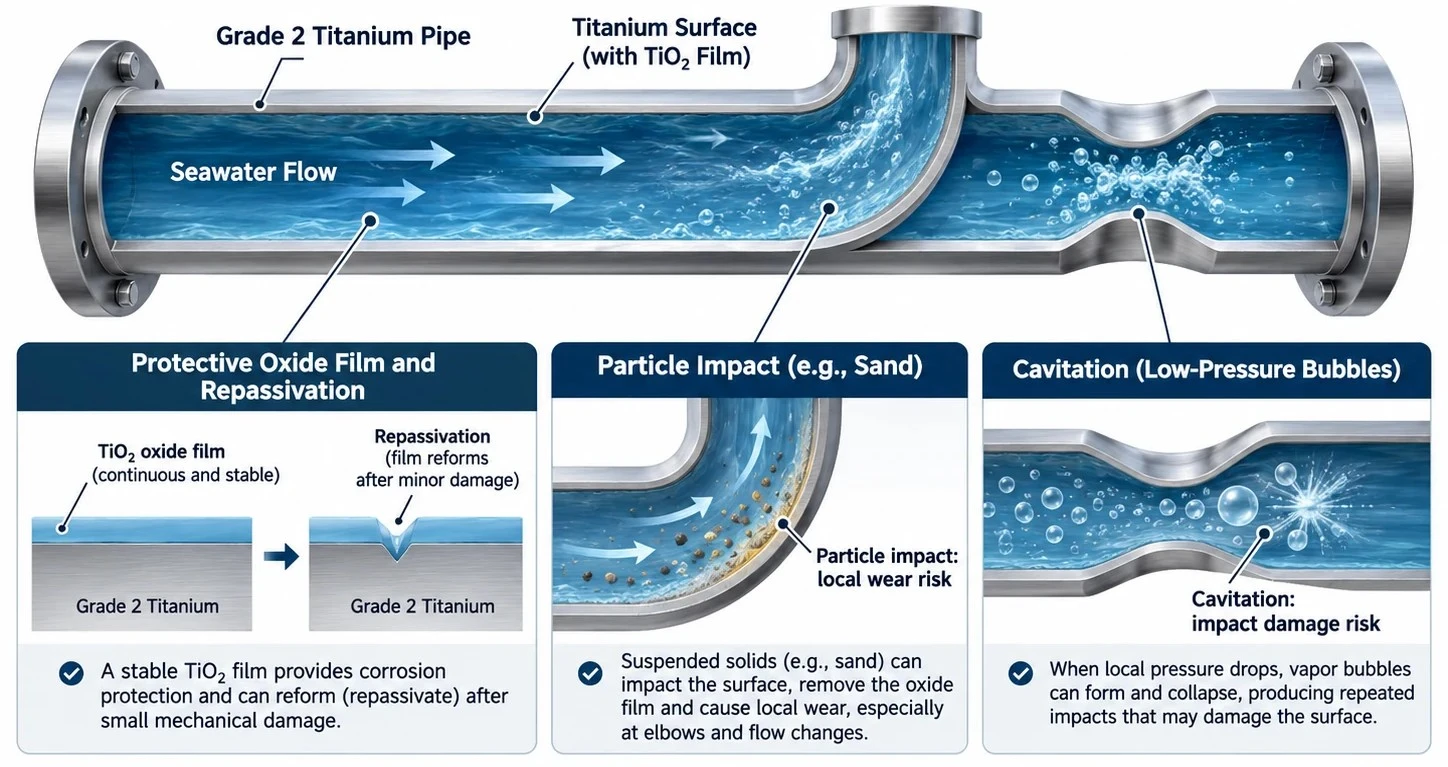
echnical illustration: oxide-film protection, particle impact, and cavitation in flowing seawater. Not a design qualification test.
Key takeaway: Clean, high-velocity seawater does not automatically imply severe titanium erosion. Suspended solids, cavitation, and local geometry require separate assessment.
What Is Erosion-Corrosion in High-Velocity Seawater?
Erosion-corrosion combines mechanical surface damage with electrochemical corrosion. Fast-moving water, suspended particles, or localized impacts can remove material or damage protective surface films. Corrosion may then contribute to further metal loss.
The process depends on the interaction between mechanical forces and chemical reactions. High velocity alone does not always produce high erosion-corrosion rates.
How Does Seawater Flow Affect Metal Surfaces?
Seawater contains dissolved salts, oxygen, and other substances that influence corrosion. When water moves through a pipe, its velocity and flow pattern affect the metal surface.
Important factors include:
- Average flow velocity and local turbulence
- Sand and suspended solids
- Water temperature and chemistry
- Pipe geometry and surface condition
- Cavitation and pressure fluctuations
The material's protective film and the type of mechanical impact also matter.
Erosion, Corrosion, and Cavitation Are Different
Corrosion involves chemical or electrochemical reactions that deteriorate metal. Erosion involves mechanical removal through repeated fluid or particle impact. Cavitation occurs when vapor bubbles form and collapse due to local pressure changes.
A seawater system may experience one mechanism or several interacting mechanisms. Identifying the actual damage process helps engineers select effective protection measures.
Why Does Grade 2 Titanium Resist Seawater Erosion-Corrosion?
Grade 2 Titanium, designated UNS R50400, belongs to the commercially pure titanium family. It combines moderate strength, useful ductility, and excellent resistance in many chloride-containing environments.
Its corrosion resistance comes mainly from a protective titanium oxide film.
The Protective Titanium Oxide Layer
Titanium naturally forms a thin oxide film in suitable environments. This layer separates the underlying metal from seawater and limits corrosion reactions.
If mechanical damage occurs, the film can reform when local conditions support repassivation. This behavior helps Grade 2 withstand many flowing seawater environments.
Repeated impacts can still cause damage when mechanical forces exceed the surface's resistance.
Why Titanium Performs Well in Flowing Seawater
Grade 2 offers excellent resistance to general seawater corrosion and chloride-induced pitting. It also performs well against erosion-corrosion in many clean-seawater conditions.
Its relatively low density helps engineers reduce component weight compared with stainless steel. These advantages support seawater-contact tubing and cooling equipment.
Strong corrosion resistance does not mean immunity to abrasive wear or cavitation damage.
How Fast Can Seawater Flow Over Grade 2 Titanium?
Engineers often ask about the maximum acceptable seawater velocity for titanium. Published technical data demonstrate strong performance at high velocities, but results depend on test conditions.
What Published Technical Data Show
Alleima's Grade 2 titanium material information reports excellent erosion resistance in flowing seawater at velocities approaching 40 m/s (approximately 130 ft/s) in cited conditions. TIMET literature also discusses titanium's performance in high-velocity seawater.
These findings support titanium's reputation in seawater cooling systems. They do not establish a universal velocity limit for design.
Why 40 m/s Is Not a Universal Operating Limit
An individual test cannot represent every piping system. Real equipment contains elbows, reducers, pumps, valves, and other flow disturbances. Local impact conditions may differ greatly from average velocity in straight tubing.
Engineers must review tube diameter, wall thickness, suspended solids, vibration, pressure losses, and pump requirements. The correct design velocity needs a complete hydraulic and mechanical assessment.
Never treat a published erosion test velocity as a guaranteed operating rating for every Grade 2 tube.
How Do Sand Particles Affect Grade 2 Titanium?
Natural seawater can contain sand, sediment, and suspended solids. These particles create mechanical damage risks when they strike metal surfaces.
Particle Impact and Surface Damage
Sand particles can contact tubing walls, especially near changes in flow direction. They may damage the oxide film and remove small amounts of material.
Damage depends on particle size, hardness, concentration, velocity, and impact angle. Studies of commercially pure titanium under particle-impingement conditions highlight why velocity alone cannot predict material loss.
Why Elbows and Inlets Need Attention
Straight tubing may experience comparatively uniform flow. Bends and inlet regions can concentrate particle impacts.
Pay particular attention to:
- Pump discharge connections and pipe elbows
- Tube entrances and flow restrictions
- Sudden changes in pipe diameter
- Locations with sediment accumulation
Suitable flow distribution, filtration, and geometry can reduce risk. Severe sediment conditions may warrant representative erosion testing.
Can Cavitation Damage Grade 2 Titanium?
Yes. Titanium can experience cavitation damage under sufficiently severe conditions. Cavitation develops when local pressure becomes low enough for vapor bubbles to form.
When bubbles collapse near a solid surface, they create concentrated mechanical impacts. Repeated collapse can gradually damage the surface.
Where Cavitation May Occur
Potential locations include pump impellers, control valves, high-velocity restrictions, poorly designed bends, and sudden pressure changes.
How Can Engineers Reduce Cavitation Risk?
Good hydraulic design is essential. Review pump suction conditions, pressure losses, valve selection, and local flow restrictions. Adequate pressure margins help reduce cavitation risk.
Material selection remains important, but it cannot replace proper hydraulic design.
Grade 2 Titanium vs Stainless Steel and Copper-Nickel
Several metals serve in marine cooling equipment. Their erosion-corrosion behavior differs because they form different protective surface layers.
| Material | General Seawater Corrosion | Flow-Related Considerations |
|---|---|---|
| Grade 2 Titanium | Excellent in many ordinary conditions | Strong resistance in many clean-seawater conditions; assess particles and cavitation |
| 316L Stainless Steel | Localized corrosion can occur | Pitting and crevice corrosion may govern selection |
| Copper-Nickel Alloys | Good marine performance in suitable service | Velocity, turbulence, and protective-film stability require control |
Grade 2 offers useful corrosion resistance and low weight. However, the best decision requires full operating data.
When Is Grade 2 Preferable?
Grade 2 deserves consideration when seawater continuously contacts equipment surfaces. It may also provide value when corrosion-related maintenance is costly.
Stainless steel or copper-nickel can remain suitable under different conditions. Compare realistic service life, manufacturing cost, and inspection needs rather than purchase price alone.
Typical Applications in High-Flow Seawater Systems
Marine Heat Exchangers
Heat exchangers transfer energy between fluids through metal surfaces. Seawater cooling circuits require tubes that resist corrosion and maintain structural integrity.
Grade 2 titanium tubes offer excellent resistance in many seawater environments. Engineers still need to consider fouling, vibration, heat transfer, and mechanical loads.
Explore our Titanium Tubes for Heat Exchangers application page.
Surface Condensers
Surface condensers circulate cooling water through many tubes. Grade 2 titanium can reduce corrosion-related tube damage in suitable seawater service.
Tube supports, inlet distribution, cleaning practices, and vibration control remain essential.
Desalination Equipment
Desalination systems handle seawater and concentrated brines. Grade 2 tubing provides corrosion resistance in many relevant environments.
Designers must still evaluate temperature, salinity, pressure, and deposits.
Marine Cooling and Offshore Systems
Offshore equipment often needs corrosion-resistant piping and cooling parts. Grade 2 can perform well where seawater exposure is continuous.
Read more in Titanium for Marine and Seawater Applications.
How Can Engineers Reduce Erosion-Corrosion Risks?
Improve Flow Distribution
Avoid unnecessary restrictions and abrupt flow changes. Well-designed inlets can reduce local velocity peaks and uneven distribution.
Review turbulence where pipes connect to vessels or tube sheets.
Control Suspended Solids
Filtration and sediment management can reduce abrasive exposure. Cleaning procedures should prevent deposits in critical locations.
Select filtration methods according to actual particle size and concentration.
Prevent Vibration and Mechanical Damage
High flow can induce vibration in poorly supported tubing. Repeated movement may cause wear at supports or increase fatigue risk.
Proper support, installation, and vibration assessment improve system reliability.
ASTM Standards and Testing for Grade 2 Titanium Tubes
Buyers should specify the appropriate standard for each product form.
| Standard | Product Scope |
|---|---|
| ASTM B338 | Seamless and welded titanium tubes for condensers and heat exchangers |
| ASTM B861 | Seamless titanium and titanium alloy pipe |
These standards define material and manufacturing requirements. They do not set a universal seawater velocity for every system.
What Tests Should Buyers Request?
Procurement documents may require:
- Chemical composition and mechanical testing
- Dimensional and surface inspection
- Applicable nondestructive examination
- Hydrostatic or other specified pressure testing
- Mill test reports and heat traceability
For severe erosion-corrosion service, buyers may request application-specific evidence. ASTM G73 concerns certain liquid-impingement erosion tests, not every slurry or continuous-flow condition.
Explore the TSM Titanium Standards resource for additional information.
How to Select Grade 2 Titanium Tubing for Your Project
Choosing tubing requires both material specifications and accurate engineering inputs. Before requesting a quotation, prepare:
- Required product form and ASTM standard
- Outside diameter, wall thickness, and length
- Design pressure and operating temperature
- Normal and maximum seawater velocity
- Sand or suspended-solid concentration
- Required inspection and testing records
- Order quantity and delivery requirements
For demanding flow conditions, share details about pumps, bends, restrictions, and cleaning procedures. These inputs help suppliers understand your requirements.
Grade 2 Titanium Products From TSM Technology
At TSM Technology, we manufacture and supply titanium materials for marine, chemical, and industrial applications.
Our range includes titanium tubes, plates, bars, forgings, flanges, and machined components. We discuss material specifications, dimensions, inspection documentation, and custom processing with customers.
For seawater projects, our team can review Grade 2 tubing requirements according to the relevant standards.
Explore our Grade 2 Titanium products. Final availability and production specifications require order confirmation.
Frequently Asked Questions
Is Grade 2 Titanium Resistant to High-Velocity Seawater?
Yes. Technical data report excellent performance under many high-velocity seawater conditions. Actual behavior depends on local flow, particles, and operating conditions.
What Is the Maximum Seawater Velocity for Grade 2 Titanium?
No universal limit applies. Some technical material data report good performance near 40 m/s under specific conditions. This is not a design guarantee.
Does Sand Cause Erosion in Titanium Pipes?
Sand can cause mechanical wear, particularly where particles repeatedly strike a surface. Concentration, velocity, and impact angle influence damage.
Can Grade 2 Titanium Experience Cavitation Damage?
Yes. Severe vapor-bubble collapse can damage titanium mechanically. Hydraulic design helps reduce this risk.
Which ASTM Standard Applies to Grade 2 Heat Exchanger Tubes?
ASTM B338 covers seamless and welded titanium tubes for condensers and heat exchangers. Confirm the applicable edition and inspection requirements.
Choose Grade 2 Titanium for Your Seawater Project
Grade 2 Titanium combines excellent corrosion resistance with strong erosion-corrosion performance in many flowing seawater environments. Its oxide film supports reliable service in cooling, heat exchange, and desalination equipment.
Sand impacts, cavitation, vibration, and hydraulic design still need attention.
Looking for Grade 2 Titanium tubing for a seawater project? Contact TSM Technology at info@tsm-titanium.com. Share your dimensions, quantity, ASTM standard, and operating conditions for a quotation.
Request a Grade 2 Titanium QuotationReferences
- Alleima. Alleima Ti Grade 2: Seamless Tube and Pipe Material Datasheet.
- TIMET. Corrosion Resistance of Titanium.
- TIMET. Titanium Design and Fabrication Handbook.
- The Role of Surface Film on the Critical Flow Velocity for Erosion-Corrosion of Pure Titanium. Wear, 2019.
- ASTM International. ASTM B338: Standard Specification for Seamless and Welded Titanium and Titanium Alloy Tubes for Condensers and Heat Exchangers.
- ASTM International. ASTM B861: Standard Specification for Titanium and Titanium Alloy Seamless Pipe.


